


- Home
- Companies
- Jiangsu Grand-Hope New Materials ...
- Applications
- Carbon Felt Fiber Optics for ...
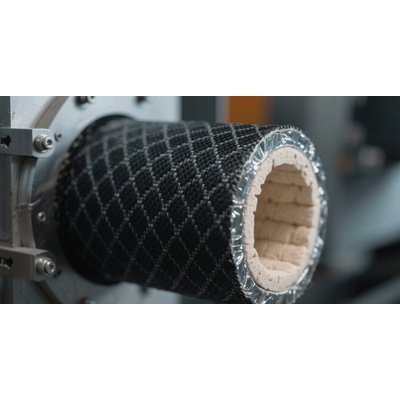
Carbon Felt Fiber Optics for High-Temperature Industrial Furnace - Energy
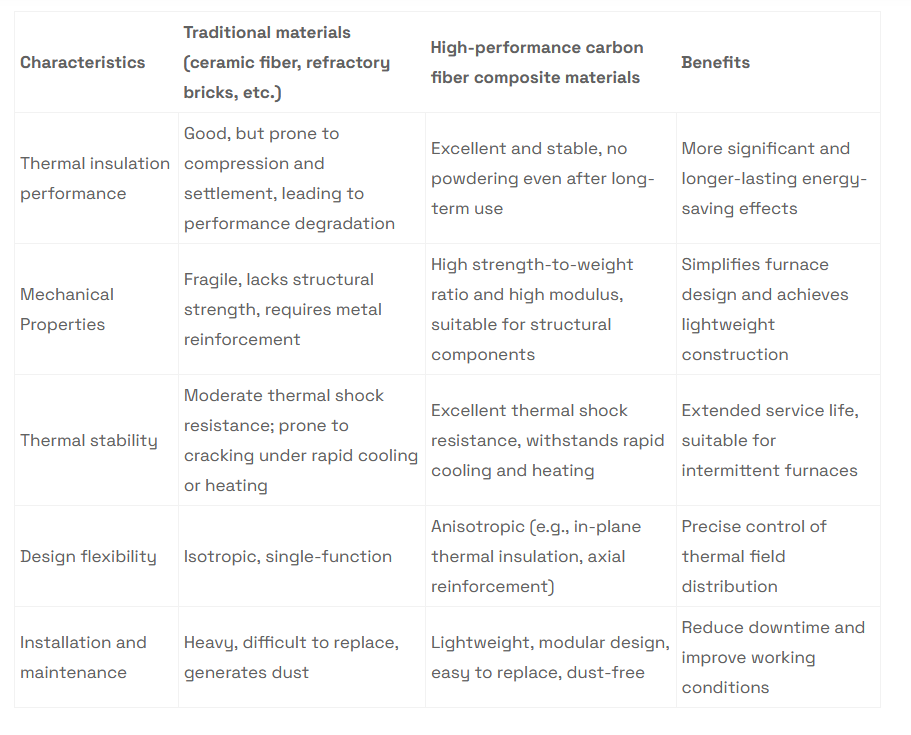
Application of High-Performance Carbon Fiber Insulation Materials in Industrial Furnaces. High-performance carbon fiber insulation materials offer significant advantages over traditional materials, as demonstrated below:
Intermittent high-temperature heat treatment furnace
Intermittent high-temperature treatment furnaces include aluminum alloy solution treatment furnaces for aerospace applications, titanium alloy forming furnaces, and high-alloy steel quenching furnaces. These furnaces require frequent door opening and closing, and the workpieces and racks inside the furnace are heavy, placing high demands on the load-bearing capacity and impact resistance of the furnace chamber bottom and side walls.
Value provided by carbon fiber composite insulation materials:
Significant energy savings: reduced thermal inertia, faster heating rates, and energy consumption reduced by 20-40%.
Improved production efficiency: Faster heating and cooling rates shorten process cycles.
Increased effective working space: Thinner yet stronger furnace walls increase the effective volume of the furnace chamber.
Extended service life: Excellent thermal shock resistance perfectly adapts to frequent hot-cold cycles.
Atmosphere-Protected Sintering Furnaces
Atmosphere-controlled sintering furnaces are used in applications such as polysilicon ingot furnaces for the photovoltaic industry, lithium-ion battery cathode material sintering furnaces, and high-end magnetic material sintering furnaces. These furnaces typically operate in inert gases or specific atmospheres, with stringent requirements for temperature uniformity (±3–5°C) and atmosphere purity.
Value delivered by carbon fiber composite insulation materials:
Atmosphere-controlled sintering furnaces are used in applications such as polysilicon ingot furnaces for the photovoltaic industry, lithium-ion battery cathode material sintering furnaces, and high-end magnetic material sintering furnaces. These furnaces typically operate in inert gases or specific atmospheres, with stringent requirements for temperature uniformity (±3–5°C) and atmosphere purity.
Improved product consistency: Unparalleled temperature uniformity directly enhances the quality and yield of sintered products.
Protects atmosphere purity: The material itself has low volatility and is non-contaminating, unlike some insulation materials that release impurities and contaminate the furnace atmosphere and products.
Precise control: Provides process engineers with a powerful tool to actively design the thermal field rather than passively adapt to it.
Vacuum high-temperature furnaces
Vacuum high-temperature furnaces include silicon carbide sintering furnaces (>2000°C), sapphire crystal growth furnaces, and ultra-high vacuum brazing furnaces. In a vacuum environment, heat cannot be dissipated through convection and is primarily transferred by radiation, imposing extremely stringent requirements on the stability and low volatility of insulation materials.
Value provided by carbon fiber composite insulation materials:
Vacuum high-temperature furnaces include silicon carbide sintering furnaces (>2000°C), sapphire crystal growth furnaces, and ultra-high vacuum brazing furnaces. In a vacuum environment, heat cannot be dissipated through convection and is primarily transferred by radiation, imposing extremely stringent requirements on the stability and low volatility of insulation materials.
Extended service life: Extends the replacement cycle of thermal field components from months to years, significantly reducing maintenance costs and downtime.
Excellent process stability: Thermal field performance does not degrade, ensuring extremely high process repeatability between furnace cycles.
Safety and reliability: Eliminates the risk of short circuits caused by insulation layer powdering or collapse.