

- Home
- Companies
- Volstora B.V.
- Articles
- Battery Throughput - Case Study
Battery Throughput - Case Study
The amount of energy that the battery stores and releases is measured in kWh and is called throughput and is useful to compare the practical cost of electricity between different models of energy storage.
Degradation
Degradation is the business case killer for its compounding effect on reducing the future energy storage revenue.
The two questions are what is the calendar life and what is the cycle life of the storage in question.
- 22000+ cycles at 100% DoD
- 1% yearly degradation
- 98% Round-trip efficiency
- €500/kWh
- 4000 cycles at 90% DoD
- 3% yearly degradation
- 97% Round-trip efficiency
- €300/kWh
- 3000 cycles at 80% DoD
- 5% yearly degradation
- 96% Round-trip efficiency
- €200/kWh
We are comparing 3 different batteries looking at their main properties. We will assume that the batteries will be used every day.
Note that some of the cycles are not at 100% DOD which means that the actual price per usable kWh is slightly higher. For example, Soap’s battery must be sized 25% larger to have a usable kWh which is €200/0.8 = €250/kWh.
Note that the battery end-of-life is at 70% by which the battery will have much faster degradation and potentially some heating issues.
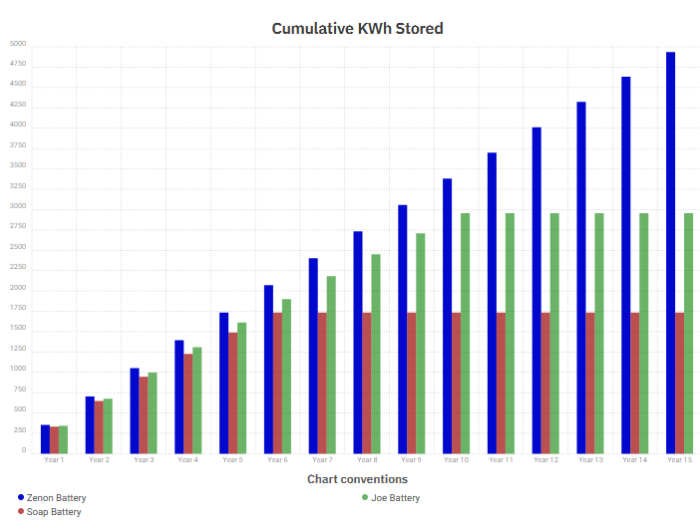
The battery throughput is calculated above for 1 cycle per day and taking the degradation and efficiency into account. Note how the Soap battery (red) although least expensive has a markedly lower throughput.
The Joe battery (green) performs quite well up to year 10 but is then end-of-life.
Effective cost per kWh
- cost / Year 5
- cost / Year 7
- cost / Year 10
- cost / Year 12
- cost / Year 15
€500
- €0.288 (1734kWh)
- €0.208 (2403kWh)
- €0.148 (3380kWh)
- €0.125 (4013kWh)
- €0.10 (4936kWh)
€330
- €0.205 (1610kWh)
- €0.151 (2181kWh)
- €0.111 (2956kWh)
- –
- –
€250
- €0.168 (1489kWh)
- €0.144 (1734kWh)
- –
From this picture it would seem that the Joe’s battery is most attractive for the overall energy storage system and the Soap’s battery is only effective for short-lifetime applications up to 7 years.
However, energy storage is built with more than the base cost of batteries which can skew the overall price per kWh.
Overall
Battery cost
Complete system installation
Total
- Total cost / Year 10 kWh
- Total cost / Year 15 kWh
- VOLSTORA SuperTitan€210000
- €53000
- €263000
- €0.155/kWh
- €0.107/kWh
- €165000
- €53000
- €218000
- €0.147/kWh
- –
- €125000
- €53000
- €178000
- €0.205/kWh
- –
Notice that initially, Soap’s battery is 70% cheaper than Volstora and Joe’s battery is 21% cheaper but on a system level over 10 years, Joe’s battery is 5% cheaper and Soap’s battery is 25% more expensive!
The risk with Joe’s battery is quite high, as one year of premature failure will increase the cost per kWh over 10 years by 9%. For many projects, such a high performance risk will outweigh the reward.
The Volstora storage system has a far larger safety margin as the lifetime and performance of titanium storage is more than double what LFP batteries can achieve. This is important because risk in energy storage is a major issue and the chart below illustrates the difference in risk.