
Dry reforming of model-biogas over ceria-supported nickel-based catalyst: The effect of charge-enhanced dry impregnation on the catalytic performance and coke resistance
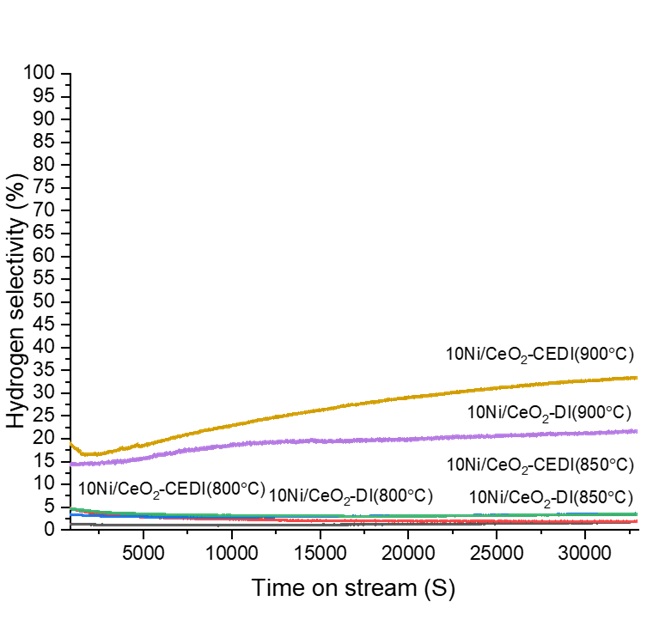
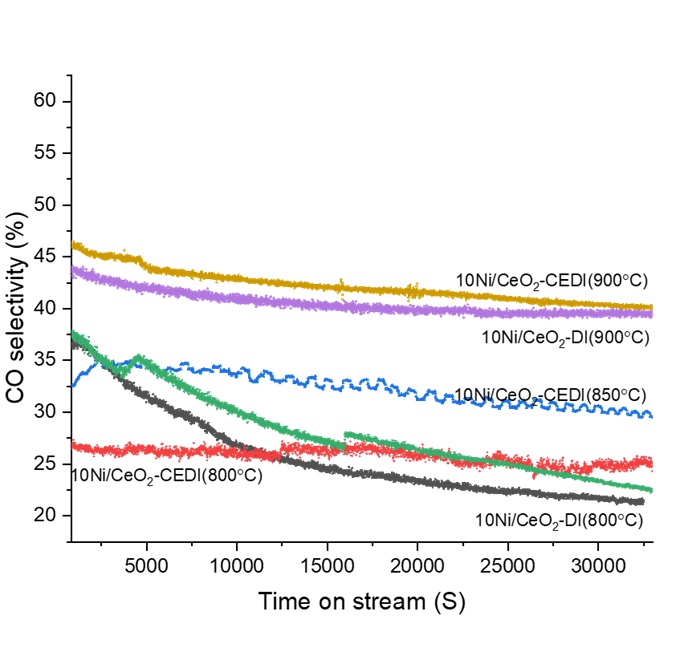
This study rigorously investigated the effect of charge-enhanced dry impregnation (CEDI) method on the physicochemical properties and catalytic performance of a ceria-supported nickel-based catalyst. The primary objective of the CEDI method was to augment the electrostatic adsorption of the nickel precursor onto the ceria support surface during the dry impregnation (DI) process. For a comprehensive comparative assessment, two distinct catalyst samples were synthesised: 10Ni/CeO2-CEDI, prepared via the CEDI method, and 10Ni/CeO2-DI, prepared using the conventional DI method, which served as the control. Both catalysts were subsequently evaluated under biogas dry reforming (BDR) conditions for the production of synthesis gas, focusing on critical performance metrics such as model-biogas feed conversion (XCH4 and XCO2), selectivity of desirable products (SH2, SCO) and by-products (H2O, C), and the propensity and type of undesirable carbon formed on the catalysts.
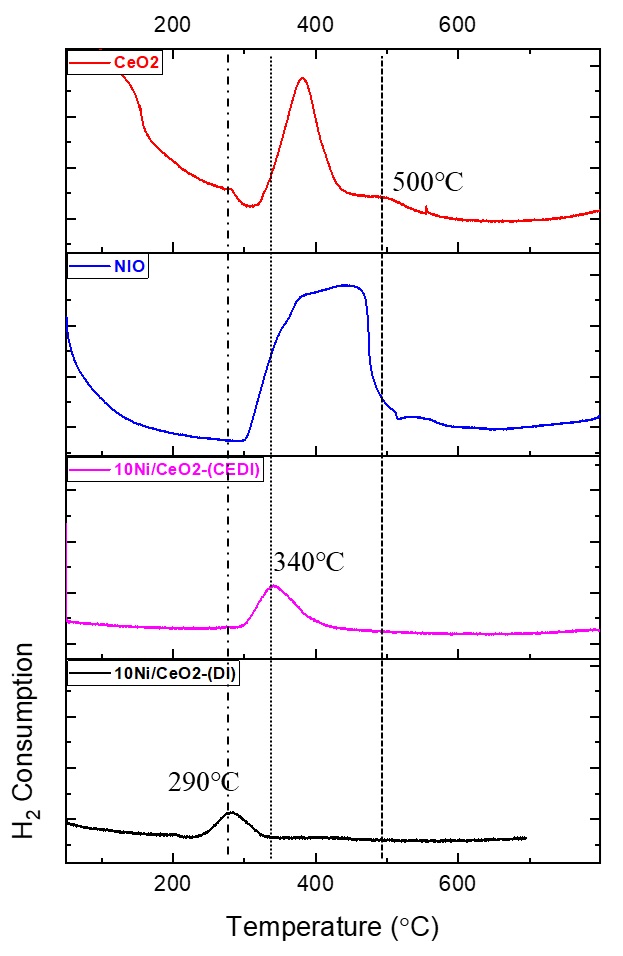
To elucidate the influence of the CEDI preparation technique, a suite of advanced characterisation techniques was systematically used on both the fresh and spent catalysts. These techniques encompassed structural analysis using X-ray diffraction (XRD), surface area and porosity assessment via adsorption/desorption, and surface electronic state investigation using X-ray photoelectron spectroscopy (XPS).
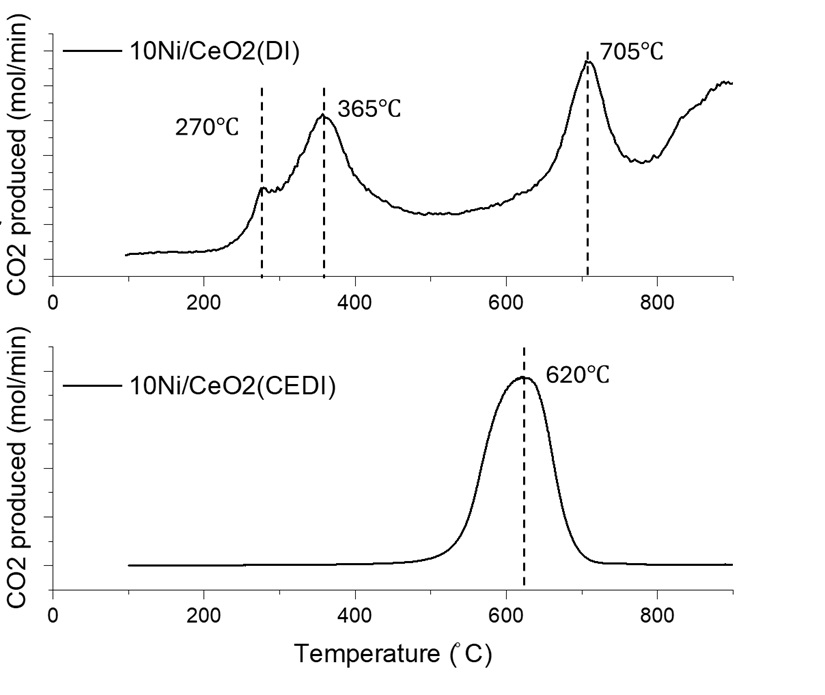
Figure 2 (left). O2– TPO profiles of 10Ni/CeO2-DI and 10Ni/CeO2-CEDI catalysts synthesised by DI and CEDI methods. The experimental conditions for these results include a model biogas feed ratio of CH4/CO2=1, GHSV of 7500 mL/h⋅gcat, and a reaction time of seven hours.
Furthermore, microscopic analysis was performed using scanning electron microscopy (SEM) and transmission electron microscopy (TEM) to determine morphology particle characteristics. Complementary analyses were conducted by using a Hiden Analytical CATLAB microreactor with a quadrupole mass spectrometer (QMS) equipped with Faraday and Secondary Electron Multiplier (SEM) detectors to
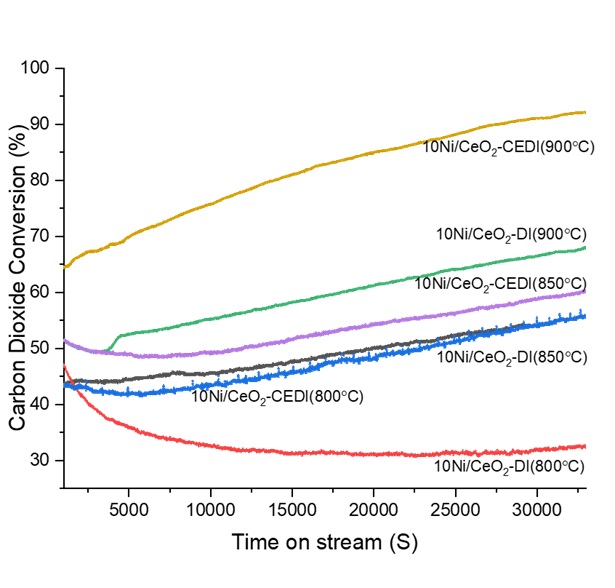
Figure 3 (right). CO2 conversion at temperatures 800 °C, 850 °C and 900 °C. The experimental conditions for these results include a model biogas feed ratio of CH4/CO2=1, a gas hourly space velocity (GHSV) of 7500 mL/h⋅gcat, and a reaction time of seven hours.
probe crucial physiochemical properties directly affected by the CEDI synthesis method. These included: H2-chemisorption to quantify dispersion of active sites, temperature-programmed reduction (H2-TPR) to assess the metal-support interaction and bulk phase reducibility of the catalysts, and Oxygen-temperature-programmed oxidation (O2-TPO) to evaluate carbon deposited on the catalysts.
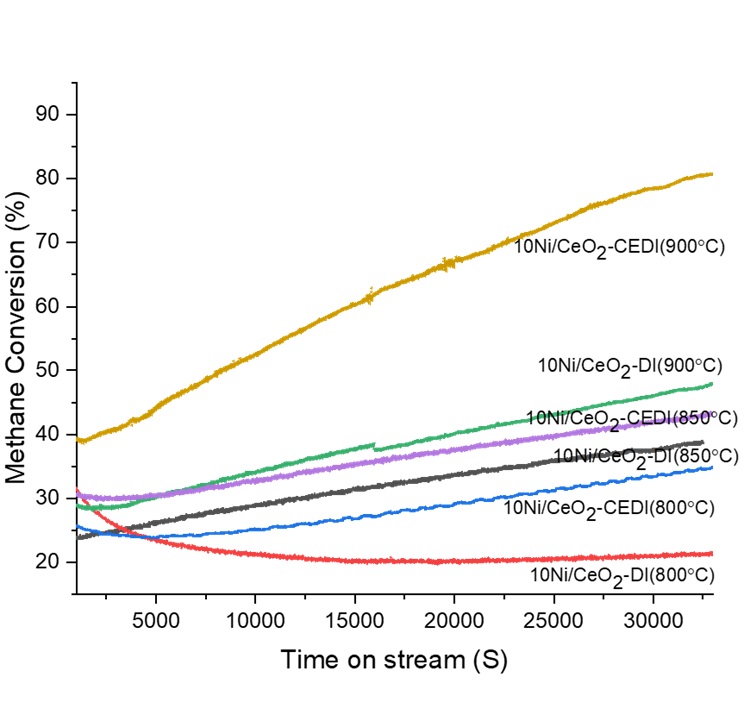
Figure 4 (left). CH4 conversion at temperatures 800 °C, 850 °C and 900 °C. The experimental conditions for these results include a model biogas feed ratio of CH4/CO2=1, a gas hourly space velocity (GHSV) of 7500 mL/h⋅gcat, and a reaction time of seven hours.
The experimental findings unequivocally demonstrated the effectiveness of the CEDI method in achieving the intended enhancement of electrostatic interactions between the nickel precursor and the ceria support. This improved interaction manifested in superior structural and electronic properties in the 10Ni/CeO2-CEDI catalyst. Specifically, the CEDI preparation led to a marked reduction in the average nickel nanoparticle size, achieving 3.33 nm, which is significantly smaller than the nanoparticle size observed in the control DI-prepared catalyst. This size reduction translated directly into a substantial enhancement in active metal dispersion, increasing from a mere 1.40% in the 10Ni/CeO2-DI catalyst to a high of 5.04% in the CEDI-prepared counterpart. Moreover, a stronger interaction between the metal and the support was evidenced by a discernible positive shift in the TPR reduction temperature that increased from 290? for the control catalyst to 340? for the CEDI-prepared catalyst. Collectively, these superior physicochemical attributes directly correlated with enhanced catalytic performance under biogas reforming conditions. The 10Ni/CeO2-CEDI catalyst exhibited both a higher biogas conversion efficiency and a substantial reduction in the rate of carbon deposition. These results validate the CEDI approach as an effective and promising technique for synthesising highly active and stable supported nickel catalysts for efficient syngas production via biogas dry reforming reaction.
Project summary by: Babusi Balopi, Institute for Catalysis and Energy Solutions (ICES), University of South Africa, Florida Campus, Roodepoort, Johannesburg, 1710, South Africa.
Paper Reference: Babusi Balopi, Joshua, G., Moyo, M. and Liu, X. (2024) ‘Dry reforming of model-biogas over ceria-supported nickel catalyst: the effect of charge enhanced dry impregnation on the catalytic performance and coke resistance.’ Research on Chemical Intermediates. Springer Science+Business Media, 50(9) pp. 4175–4198. DOI: 10.1007/s11164-024-05362-x.