

Is the Government Ending Net Metering in Pakistan?
A government official has finally addressed the net metering rumors. According to official sources, the government has revised and approved the new net metering policy. After completing paperwork and consultations with key stakeholders, the Cabinet Office has officially approved the new net metering policy in Pakistan.
The latest renewable energy draft suggests replacing Net Metering with a gross metering or net billing system to ease the electricity price burden on other consumers.
After the policy approval, solar users will now be required to sell all the electricity produced by their solar panels at a fixed rate of around Rs. 11.33 per unit. This is almost three times lower than the previous rate of Rs. 27 per unit.
Various questions are emerging in the minds of solar panel consumers, creating uncertainty and confusion. Answering all of them may be premature, but this article still guides you on what this change means and how you can still benefit under the new net metering policy.
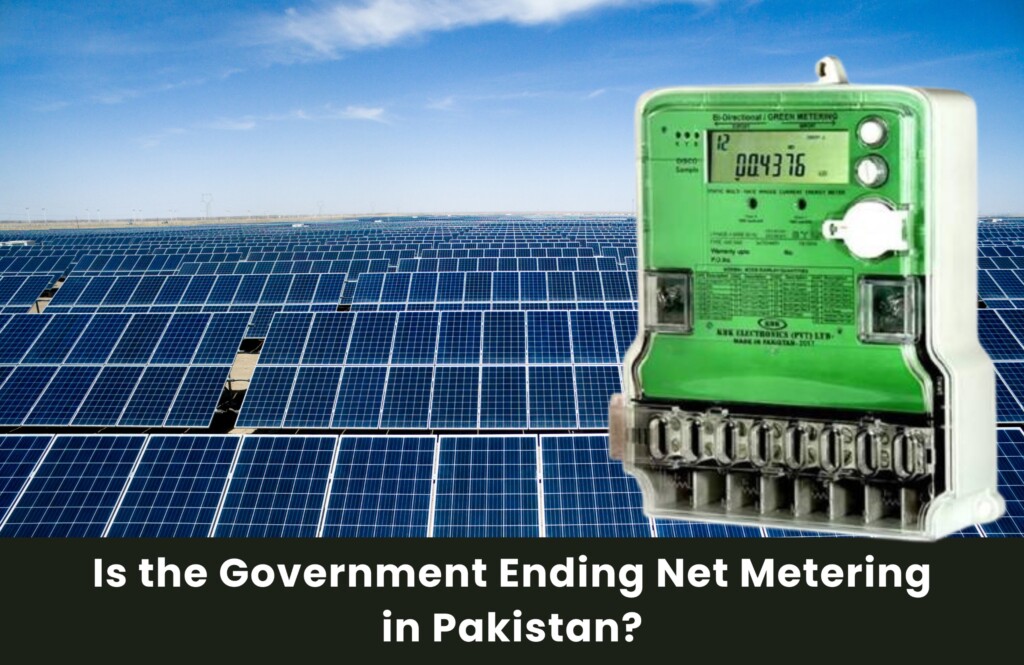
The discussion over reducing the net metering rate or ending it entirely isn’t new. Even last year, the power minister had to issue a clarification stating that the government wasn’t planning to end net metering policies anytime soon. However, one thing is now clear: net metering will be replaced with gross metering, and the rate will be 60% lower than the previous rates.
Solar panel users who are already selling excess electricity to the grid under the current net metering policy will continue receiving Rs. 27 for every unit sold.
With net metering, you have the authority to consume the solar-produced electricity first (or your own use and then sell the excess electricity to the grid. However, in gross metering, the process completely changes. It requires you to sell all the electricity produced by your Solar Panels directly to the grid at a lower rate, about one-third of the usual rate, and then purchase electricity from the grid at much higher rates.
For better understanding, we`ve broken it down in a simple way.
- You consume your generated solar power first.
- Any excess electricity is sent to the national grid.
- You get credit for the surplus units exported.
- At the end of the billing period, your bill reflects:
- Units consumed from the grid minus units exported to the grid.
- This system helps reduce your electricity bill substantially.
- All electricity generated by your solar panels is sent directly to the national grid.
- You do not use your solar power directly.
- You`re paid a fixed rate (usually lower than the retail rate) (or every unit exported.
- Meanwhile, your own electricity usage is charged at the standard grid rate.
- Essentially, you sell 100% of your solar generation and buy back 100% of your consumption.
Officials from the Power Division continuously stress that the current net metering policy has placed an unsustainable financial burden of almost 159 billion on other electricity consumers.
Another report suggests that 103 billion out of this 159 billion is due to the higher purchase rates under the net metering policy.
The government argues that the new gross metering policy will help balance the system and create more equitable cost sharing (Source: GEO News).
- If you still want to save big on your electricity bills and avoid prolonging your ROI period, it is highly recommended not to opt for net metering or gross metering services anymore.
- With the new policy shift, solar panel owners will have to rely entirely on grid power again, and at much higher rates as well.
- If all your solar generation is forced to be sold at a low fixed rate (gross metering), it will:
- Not to reduce your electricity bills directly.
- Simply make you a small-scale power seller, not a self-power user.
- Monitor NEPRA & Government Updates:
- Keep track of policy changes. Once gross metering becomes mandatory (if it does), small-scale residential users should prioritize off-grid/self-consumption setups with batteries.
Is net metering officially ending in Pakistan, or are these still just rumors?
The federal government is indeed moving to end solar net metering, with the Power Division having finalized a new policy and the ECC already approving amendments.
What is the proposed new buyback rate for solar electricity under gross metering?
The proposed buyback rate under Gross Metering is around Rs. 10-11.33 per unit significantly lower than the current Net Metering rate of approximately Rs. 27 Der unit.
Will existing net metering users be affected by this proposed change, or will their current agreements remain valid?
Existing net metering consumers with valid licenses/agreements will reportedly remain under their current rates and terms until their licenses or agreements expire.
How long will existing net metering contracts remain valid?
For 7 years, as per their existing agreement terms.
Why is the government making this change?
The government cites an "unsustainable financial burden" of approximately Rs. 159 billion (Rs. 103 billion from higher purchase rates) on other electricity consumers due to the current net metering system.
What does this mean for the return on investment (ROl) for new solar panel installations in Pakistan if gross metering is implemented?
The significantly lower buyback rate under gross metering will substantially prolong the ROI period (or new solar installations, potentially from 3-4 years to 10-12 years.