


Greatcell Solar Materials Pty Ltd products
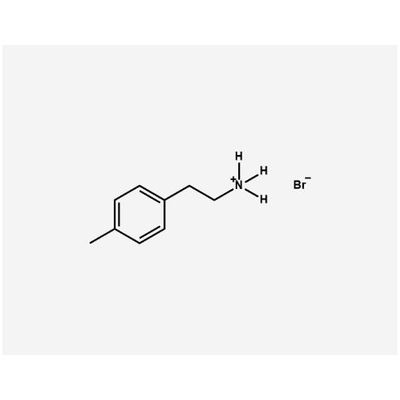
Greatcell Solar Materials - Model MS300990 - 4-Methylphenethylammonium Bromide
Greatcell Solar Materials is releasing novel perovskite precursors in the Phenethylammonium series. The presence of a methyl group in the position 4 of the organic spacer cation Phenethylammonium (PEA) is expected to contribute to a boost in the photovoltaic performance of quasi-2D perovskite solar cells. Use Greatcell Solar Materials` high purity 4-Methylphenethylammonium bromide (4-MePEABr) for your research projects.
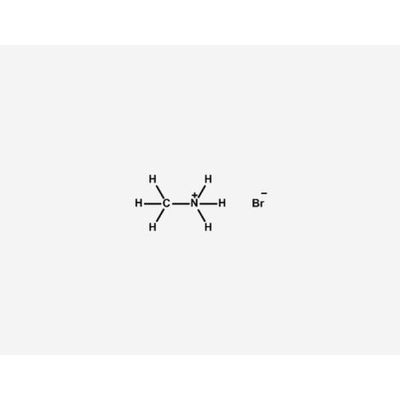
Greatcell Solar Materials - Model MS301000 - Methylammonium Bromide >99.99% | CAS 6876-37-5
Methylammonium Bromide (MABr; MAB; CAS 6876-37-5) is a common precursor used in the preparation of perovskite-based opto-electronic systems including perovskite solar cells (Wang et al., 2022) and perovskite Light-Emitting Diodes (Lai et al., 2020). Methylammonium Bromide is used to form methylammonium lead tribromide (MAPbBr3) perovskites as well as mixed cation and mixed halide perovskites (Günzler et al., 2021). MAB was added to the precursor solution of an organic–inorganic metal halide perovskite for gas sensor applications to detect NO2 gas (Duong et al., 2022). With a purity level > 99.99%, lowest moisture content and batch-to-batch reproducibility, Greatcell Solar Materials` Methylammonium Bromide is ultra-pure for consistent results and superior performance. MABr is a free flowing powder, snow white in appearance. Greatcell Solar Materials can provide g to kg quantities.
Greatcell Solar Materials - Model MS006320 - DYAG50 Conductive Silver Printing Ink
Greatcell Solar Materials` DYAG50 Conductive Silver Printing Ink is manufactured under stringent quality control protocols and quality assurance procedures. DYAG50 Conductive Silver Printing Ink is a specially formulated ink which provides exceptionally high conductivity at low cure temperatures. This highly conductive ink provides extremely low resistance of printed conducting tracks essential for the photovoltaic industry and is a key enabler in plastic electronics such as DSSC, OPV, and CdTe solar cells etc., by providing lowest track resistances of printed current collectors. DYAG50 Conductive Silver Printing Ink is comprised of a mixture of pure silver particles and organometallic silver compound in an organic medium. When printed on polyester (PET or PEN) films and then cured at 160-180°C, the particles consolidate to form a ”chemically welded” continuous silver track to yield exceptionally low bulk resistivity.
Perovskite Solar Cells
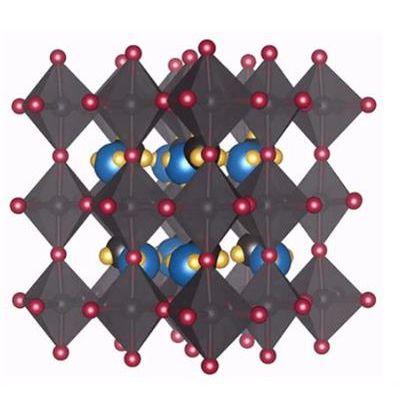
Perovskite Solar Cells (PSC) have their genesis in Dye Solar Cells (DSC). Rather than an incremental change, PSC burst onto the scene with a world-record in emerging photovoltaic (PV) technologies by Greatcell Solar’s research partner EPFL. This radical step change largely rendered DSC and Organic PV (OPV) obsolete in one fell swoop, giving dramatically higher energy conversion efficiency and significantly better large-area processing. The basic building block of a PSC is the exceptionally strong light harvesting “perovskite” crystal structure (shown left). This amazing material can absorb sunlight with a hundred times thinner active layers than silicon solar cells.