


HYDROLITE products
HYDROLITE - Alkaline Electrolyzers and Fuel Cells
Hydrolite specializes in advanced electrolyzers and fuel cells essential to the efficient operation of a hydrogen economy. The company's technology leverages an alkaline framework in conjunction with Anion exchange membrane (AEM) devices, which enhances the capabilities of hydrogen generation and utilization processes. By optimizing the alkaline environment, Hydrolite provides high-reliability and cost-effective solutions for energy storage and power generation. These devices enable improved energy management by decoupling stored energy capacity from the physical size of conversion units, serving particularly well in situations where there is a discrepancy between energy production and consumption. This approach significantly boosts the efficacy of existing non-fuel storage systems, such as batteries, by facilitating flexible energy storage capabilities.
Hydrolite - Hydrolite Electrolyzer Hydrogen Generator
The Hydrolite Electrolyzer Hydrogen Generator, branded as eHG, is designed to produce hydrogen fuel leveraging renewable energy sources. Its core technology, the Anion Exchange Membrane (AEM), facilitates efficient hydrogen generation with reduced capital investment compared to conventional systems, while preserving high operational performance. The generator requires just water and electricity input, accepting a range of water qualities including regular tap water, which negates the need for deionization. This flexibility, coupled with low upfront and operational costs, makes it an attractive solution for scalable green hydrogen production. Furthermore, the device is designed to minimize the use of critical raw materials, in contrast to battery storage technologies that demand more resources. Its sustainability is notable, featuring a long lifespan of 10 years, being 95% recyclable, and operating quietly with no emissions. The generator achieves hydrogen production at 45 KWh per kilogram with a purity of 99.999%, delivering each kilogram at a cost of $1.22, excluding electricity expenses.
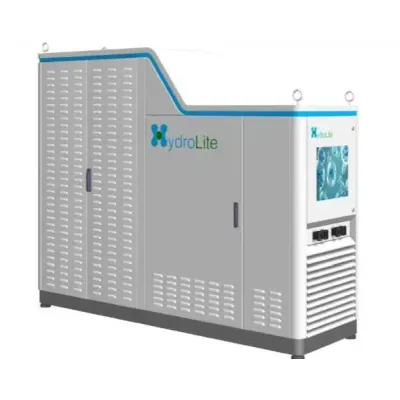
Hydrolite - Hydrolite Hydrogen Fuel Cell System
The Hydrolite Hydrogen Fuel Cell System is designed to deliver consistent, adaptable, and emissions-free power, making it ideal for applications such as uninterruptible power supply (UPS), backup, critical power, and off-grid or edge-of-grid sites. Free from diesel and fossil gas emissions, this system operates without odors, noise pollution, or fuel spills, and is fully climate-friendly when powered by green hydrogen. The system can maintain operations for over 10 hours between hydrogen cylinder exchanges or convert a short-term UPS into a virtually limitless power unit when used with battery storage. It boasts a lifespan of 10-15 years, requiring minimal maintenance. The energy unit is instantly rechargeable with hydrogen cylinder exchange, or by using the Hydrolite Electrolyzer Hydrogen Generator to produce fuel when grid-supported. Its modular design allows scaling to up to 100kW, with low capital and operational expenses, efficiency rates of 50-60%, and power outputs up to 5-10 kW as a standard unit. The system is constructed from recyclable materials, ensuring quiet and unobtrusive operation.
Hydrolite - AEM Fuel Cell Technology for Hydrogen Power Conversion
Hydrolite focuses on advancing AEM (Anion Exchange Membrane) fuel cell technology, which employs hydrogen and ambient oxygen to produce electricity. This process is fundamentally different from traditional combustion engines, as it converts chemical energy directly to electrical energy, with heat as a by-product, without involving thermal conversion. At the heart of this technology is the Membrane-Electrode Assembly (MEA), comprising layers including a gas diffusion layer and a catalyst layer, surrounding a central anion exchange membrane. In a fuel cell stack, multiple cells are electrically interconnected to enhance power output, with demonstration systems achieving up to 5 kW. The broader Hydrogen-to-Power system integrates thermal and fluidic subsystems alongside electronic interfaces for standalone power generation. The technology promises economic advantages by minimizing critical material costs while maintaining the benefits of membrane fuel cells, targeting future applications in the hydrogen economy and supporting decarbonization goals.