


ISIEVI Makina San. Tic. Ltd. Sti. products
Steam Generators
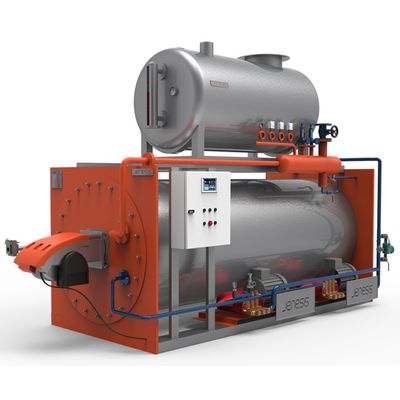
Horizontal Steam Generator
It is comprised of horizontal helical coils, and is of water-tube design. It is produced for steam capacities in the 150–4,000 kg/h range. Since the condensate tank can be installed on top of the steam generator, the latter takes up almost as much space as a vertical steam generator. The flue outlet can be positioned from the top or from behind, which facilitates the installation.
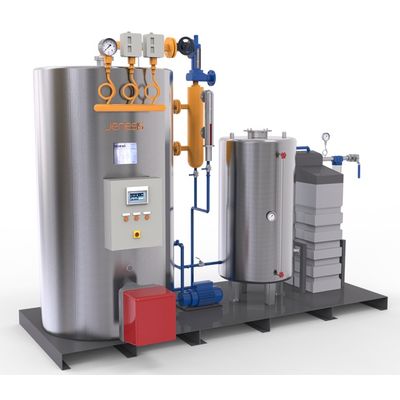
Vertical Steam Generator
It is comprised of vertical helical coils, and is of water-tube design. It is produced for steam capacities in the 100–1,000 kg/h range. While the efficiency can be increased to 95% with a non-condensing economizer, 98% efficiency can be achieved with a condensing one. If desired, steam generators can be produced as a package with a water treatment system.
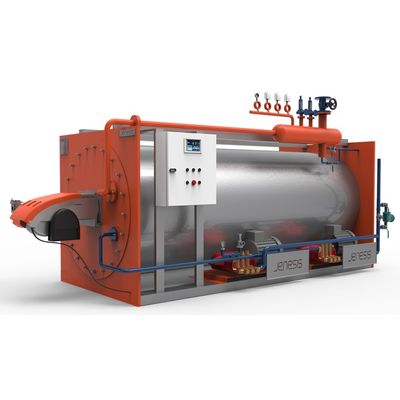
Hygienic Steam Generator
It is comprised of horizontal helical coils, and is of water-tube design. It is produced for steam capacities in the 150–4,000 kg/h range. All surfaces which steam and water are in contact with are made of AISI316L stainless steel. Depending on the feedwater quality, hygienic steam can be produced at a desired quality. Since the condensate tank can be installed on top of the steam generator, the latter takes up almost as much space as a vertical steam generator.
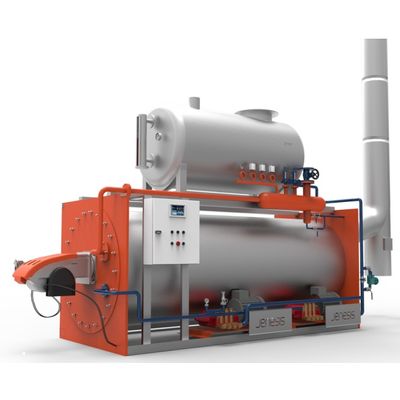
Condensing Steam Generator
It can be horizontal or vertical and is of water-tube design. It is produced for steam capacities in the 100–4,000 kg/h range. High-efficiency, low-NOx burners with electronic modulation are used. With the condensing economizer at the flue gas outlet as a standard design, and by reducing the flue gas temperature to the condensation temperature of natural gas, the efficiency reaches 98%.
Heat Recovery Systems
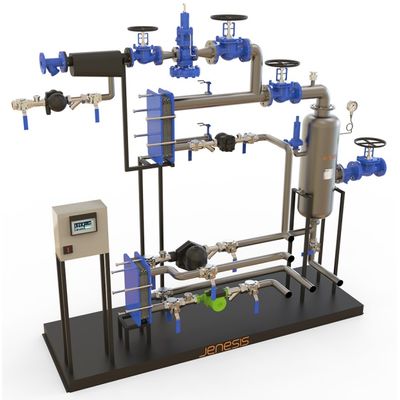
Flash Steam and Hot Water Production System
In conventional designs, the flash steam produced due to the pressure difference between the steam trap’s upstream pressure and the atmospheric pressure at the condensate tank is vented to the ambient air. However, the energy of the produced flash steam is almost tantamount to that of the returned condensate; therefore, it is highly recommended that the flash steam is recovered.
Deaerators Systems
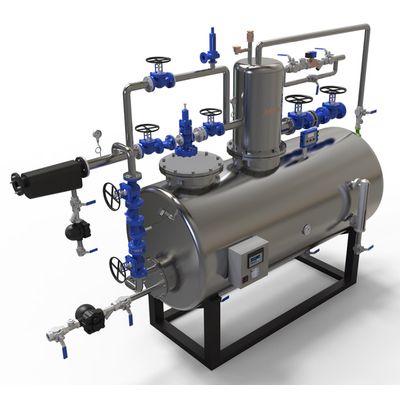
Thermal Deaerators Systems
Oxygen (O2) and carbon dioxide (CO2), which are dissolved in the feedwater, are highly corrosive gases. Thus, they must be neutralized so as to prevent corrosion of the steam generator’s metallic components. By means of thermal degassing, CO2 can be removed from the feedwater at a temperature of at least 65 °C and O2 at 102 °C and above. The released gases are then vented out from the top of the deaerator dome. This type of deaerator, which operates at 105 °C, must be placed 5m above the ground in order to prevent cavitation in the feedwater pump. If the temperature of the condensate tank can reach 80–90 °C due to the hot condensate from the processes, then all the CO2 and most of the O2 will have been removed. The remaining amount of O2 can be removed at relatively low cost by dosing oxygen scavengers in the water.
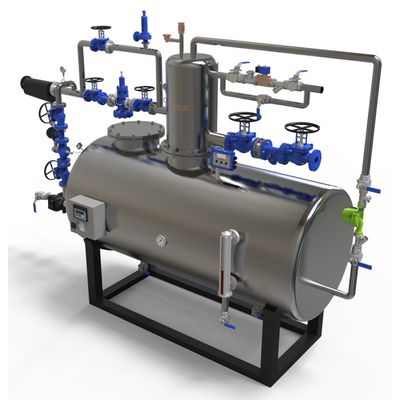
Compact Deaerator System
Oxygen (O2) and carbon dioxide (CO2), which are dissolved in the feedwater, are highly corrosive gases. Thus, they must be neutralized so as to prevent corrosion of the metallic components of the steam generator. By means of thermal degassing, CO2 can be removed from the feedwater at a temperature of at least 65 °C and O2 at 102 °C and above.
Others
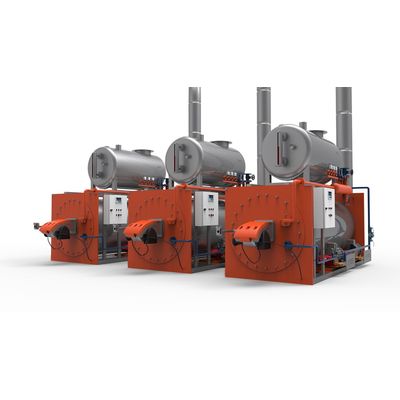
HUB Steam Generation System
The HUB Steam System is a steam production system which consists of modules of water-tube design, with horizontal helical coils. Its capacity range is between 1,000 kg/h and 100,000 kg/h. With the HUB System, the desired steam capacity can be produced by connecting modules with capacity of 1,000 – 2,000 – 2,500 – 3,000 – 4,000 kg/h in parallel. Through the HUB automation system, all modules are controlled from a central unit; the workload scheduling, i.e. aging, is such that the modules will have had equal running time within a certain period.
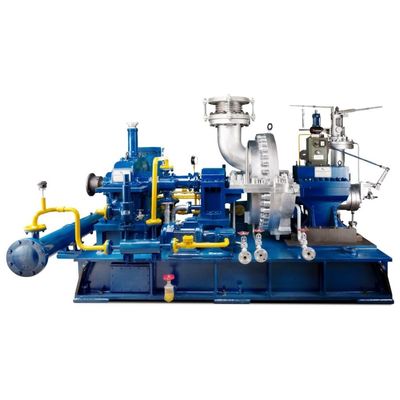
Saturated Steam Turbines
In power plants, electricity has been generated for a long time by utilizing the pressure and enthalpy of the steam. Since they operate at high speeds, steam turbines used in such facilities have high efficiency. In these types of steam turbines, superheated steam must be supplied in order to prevent the cavitation of the high-speed blades. The costs induced by the effects of potential water droplets in the saturated steam on the high-speed blades are very high. Since the initial investment and operating costs for producing superheated steam are very high, such investments do not have reasonable payback periods for factories.