

Kawasaki Gas Turbines products
Kawasaki - Model GPB Series - Gas Turbine Cogeneration System
A cogeneration system drives a gas turbine by using primary energy (fuel), and produces multiple types of secondary energy (e.g., electricity, steam) continuously. In a gas turbine cogeneration system, fuel is used as the primary energy, and multiple types of energy are produced in order to use energy more effectively. Furthermore, the system curbs NOx production and reduces environmental impact by using a gas turbine as the drive source.
Kawasaki - Model GPS Series - Standby Generator Sets
Gas turbine standby generator sets are one type of backup power source in case of an emergency such as a power outage or disaster. The Kawasaki GPS Series of gas turbine standby generator sets is comprised of a total 9 models, with output ranging from 750kVA to 6,000kVA. The system can be installed on rooftops or indoors, and also the operation and maintenance is so easy that we have earned high acclaim from our customers. We have already built up a delivery record of over 7,000 units (as of the end of March 2014, standby equipment only).
Kawasaki - Combined Cycle Power Plant
A combined cycle power generation system combines gas turbine and steam turbine to generate the maximum amount of electricity from the high-temperature thermal energy by fuel combustion. Kawasaki’s Combined Cycle Power Plant is a 10MW-90MW class power generation system equipped with , as its key component, M7A (8MW class), L20A (20MW class), or L30A (30MW class) gas turbines which are all self-developed technologies and realize high thermal efficiency, performance, and reliability. In particular, the L30A has achieved the world`s highest level of thermal efficiency in the 30MW class. In addition, the heat to power ratio can be flexibly adjusted by applying extraction type or back pressure type steam turbine. Kawasaki is capable to offer best mix plant configuration to set the optimum capacity in line with the electricity and steam demand in factories and business facilities of potential clients.
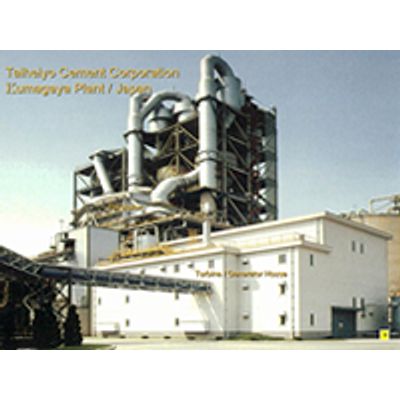
Kawasaki - Cement Waste Heat Power Plant
The Cement Plant Waste Heat Power Generation Plant is a facility to generate power by recovering heat from waste gas discharged from a cement plant. This is an energy saving system to cover approximately 30 % of the total electric consumption of a cement plant. Kawasaki has the world`s largest market share in delivering the Waste Heat Power Generation Plant to the latest cement plant with a PH tower. We have been providing this plant to the 29 cement plants worldwide including projects in progress since 1980, with its average power generation of 12, 400 kW and its maximum of 30, 500 kW. We have delivered to Indian, Taiwanese, Chinese, Vietnamese, Korean cement plants as well as Japanese cement plants.
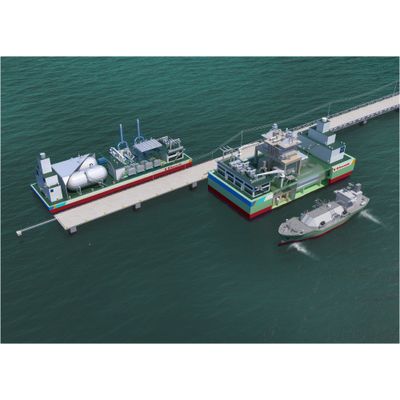
K-GRIPP - LNG Floating Power Plant
K-GRIPP is a registered trademark of Kawasaki Heavy Industries, Ltd. in Japan, U.S.A., European Union, United Kingdom, etc.
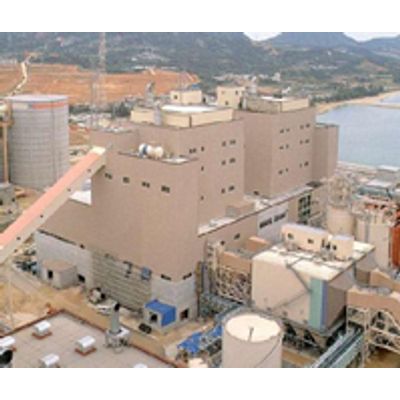
Kawasaki - Conventional Fossil Fuel Fired Power Plant
Kawasaki has delivered more than 1,000 coal-fired boiler plants. Unlike oil and gas, coal can vary greatly in its properties, depending on its region of production. Therefore, when planning a coal fired power plant, a comprehensive planning on total plant encompassing the boiler and peripheral equipment for handling and treating of the coal as well as the byproducts like ash and flue gas, is indispensable. Kawasaki is capable of such planning for all kinds of commercial and industrial coal fired boiler including their peripheral equipment.
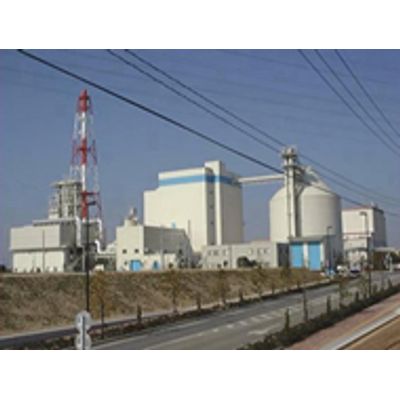
Kawasaki - Fluidized Bed Boiler
Kawasaki produces three types of fluidized bed boilers--the Bubbling Fluidized Bed Boiler (7 boilers delivered), the External Circulation Fluidized Bed Boiler (2 boilers delivered) and the Internal Circulation Fluidized Bed Boiler (2 boilers delivered). The latest `the Internal Circulation Fluidized Bed Boiler` has been developed as a highly-efficient and clean system to generate power by utilizing various waste and sludge as a `fuel` as well as waste containing corrosive substances and environmental pollutants and solid fuels derived from plastic waste. The boiler is characterized in that the fluidized bed consists of the combustion cell and the heat collection cell and the bed material circulates from the combustion cell to the heat collection cell by the velocity difference of flowing air.
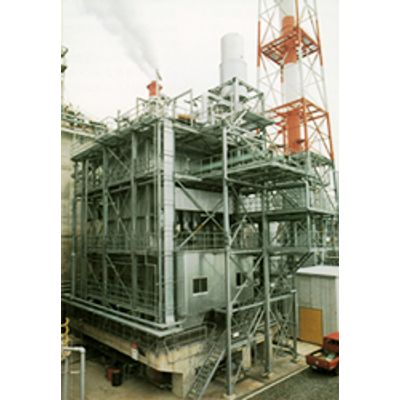
Kawasaki - Advanced Clean Combustion (KACC) Boiler
Kawasaki has developed `the Kawasaki Advanced Clean Combustion Boiler ` aiming at reducing NOx and dust emission by a completely different method from conventional ones. This boiler can reduce NOx and dust emission drastically by firing heavy oil containing much Fuel-N in a furnace made up of a high temperature reduction burning zone and a low temperature oxidation zone. We have delivered 3 boilers of an evaporation capacity of 100~200 t/h since its first delivery in 1998, all of which are acclaimed for their performance with low NOx and dust emission. This system is effective for asphalt as well as ordinary heavy oil to ensure an operation with unprecedentedly low NOx and stable and highly-efficient combustion.
Kawasaki - Model HRSG - Heat Recovery Steam Generator
The Heat Recovery Steam Generator (HRSG) recovers heat from gas turbine waste gas by steam to generate electric power by a steam turbine. This is the main product for the Combined Cycle Power Plant and the Cogeneration Plant generating electric power and steam. We have a track record in the production of many HRSGs including the generator with a capacity of 460 t/h steam and the 3-stage reheating type. So far we have delivered 59 units to the U.S., Brazil, India, Thailand, Malaysia, Myanmar, China, Mexico, Spain, the Philippines, and Iran as well as domestic companies.