


- Home
- Companies
- Plexim GmbH
- Products
Plexim GmbH products
RT Box
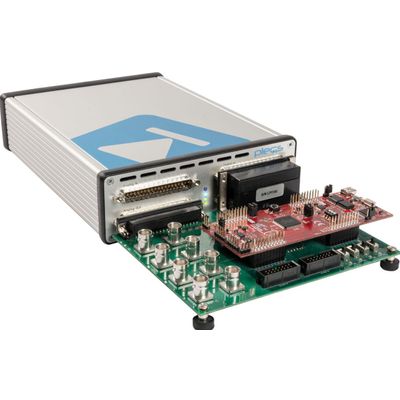
Plexim - Model CE - RT Box
The RT Box CE is a compact edition of the RT Box 1 and is offered at a very affordable price. Compared to its bigger sibling, the RT Box CE has only 8 (instead of 16) analog input channels and no high-speed interconnects. The performance of the CPU and the specifications of all other I/Os are identical to the RT Box 1. The RT Box CE is an interesting option for small HIL applications that do not require coupling multiple units. The RT Box CE is primarily intended for classroom and lab teaching, where students implement their control algorithms on a microcontroller and verify the correct operation with HIL simulations of the plant. As the RT Box CE is as small as a book it can be easily taken home by students and researchers to work remotely.
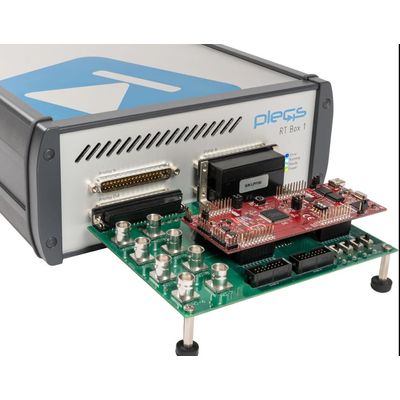
Plexim - Model 1 - RT Box
The RT Box 1 is ideally suited for HIL simulations of power electronic circuits of moderate complexity and for single-tasking control prototyping.
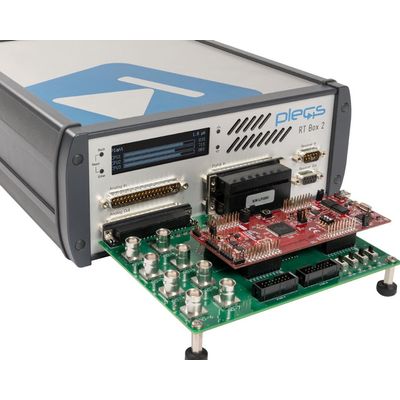
Plexim - Model 2 - RT Box
The RT Box 2 speeds up the simulation of complex models of power electronics circuits. Models that can be split into separate physical sub-systems will benefit from the parallel processing capability. The RT Box 2 also offers additional analog and digital interfaces plus a solid-state drive for data storage.If you are looking for a real-time simulator with more analog and digital I/Os, you might want to consider the RT Box 3.
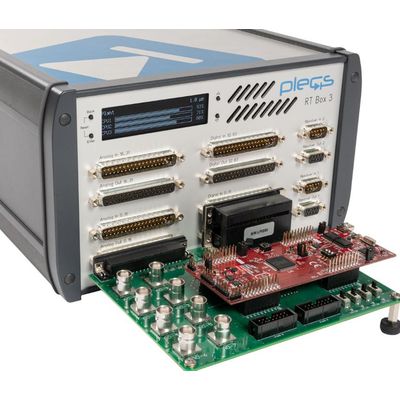
Plexim - Model 3 - RT Box
HIL simulations of multi-level converters usually require a high number of digital gate signals and analog sensor measurements. The RT Box 3 is ideal for such multi-level applications because it provides twice as many analog and digital I/Os as the RT Box 2. Otherwise, the specifications are identical to those of the RT Box 2.
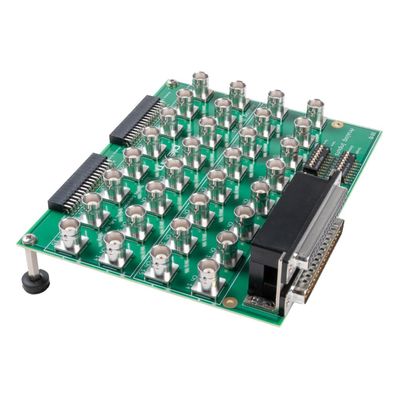
Plexim - RT Box Analog Breakout Board
The Analog Breakout Board facilitates a simple access to the analog input and output channels of the RT Box via BNC connectors. Each of the 32 channels is connected to a dedicated BNC socket on the board. DIP switches allow to individually select differential or single ended operation for all input channels. To improve the signal/noise ratio, the input impedance of each input channel can be reduced from 1 MΩ to 10 kΩ.