

S-Con Inc products
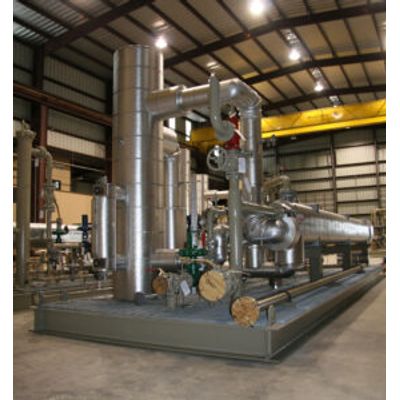
Fuel Gas Conditioning
Our JT Plants are used to condition rich natural gas for use as fuel in Natural Gas Driven Compressors and Generators and for burner systems on direct fired units such as Glycol Reboilers, Amine Reboilers and Heater Treaters. S-Con’s JT Fuel Gas Conditioning units are designed to take high pressure, high BTU/FT^3 gas and produce a fuel that has a considerably lower Btu/ft³. It would be delivered at approximately 110 PSIG. The plants are designed to handle .5 MMSCFD to 3 MMSCFD and achieve cuts of 100 to 250 Btu/ft³, depending on the conditions of the inlet stream. The cold end of the plant is rated to -100°F which allows us to handle lower temperatures that drop out more liquids. S-Con, Inc’s JT Skids are 100% pneumatically operated to allow for unattended installations, but we can provide options for electronic controls.
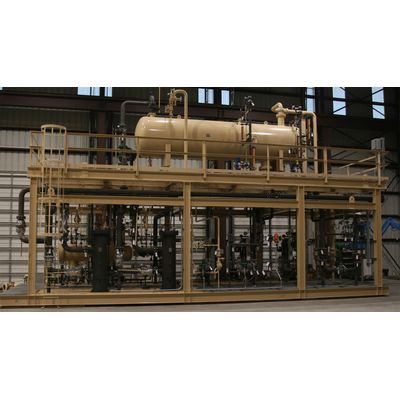
Condensate Stabilization
S-Con has the ability to design and fabricate Condensate Stabilizer Plants, ranging in size from 800 bbl/day to 10,000 bbl/day and meeting all product specifications. Condensate Stabilizers are typically used to fractionate, or “stabilize”, raw field condensate liquid that is created when low pressure natural gas streams are compressed and then cooled. The liquid is collected, free water is removed, and then the hydrocarbon is fractionated to deliver a “light-end” overhead vapor product and a “heavy-end” bottoms liquid product. The Overhead Vapor is generally used for Fuel Gas or routed back into the Compressor suction for reprocessing. The Bottoms Liquid is typically mixed with a crude oil stream or sold as crude on its own.
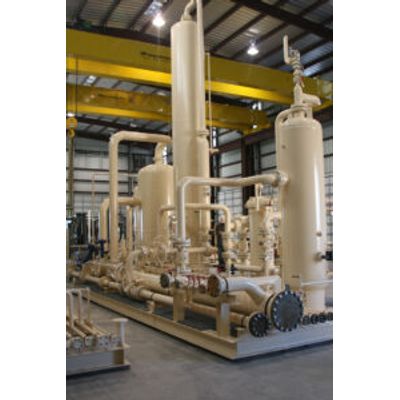
Process Separation Skids
S-Con, Inc. provides a modularized process skid option to consolidate ancillary compressor station equipment. To do this S-Con has taken equipment that is typically block mounted off skid and re-designed it as a modular skid package. Below are a few examples of what is included on one of these skids. Low Pressure Inlet Separation, Dehydration of the high pressure discharge gas, Coalescing of the dehydrated overhead gas, High Pressure Discharge Separation, Fuel Gas Separation, Inlet and Discharge ESD systems, Recycle Control.