


- Home
- Companies
- Aqua~Media International Ltd.
- Events
- Hydro 2007 - New Approaches for a New ...
Hydro 2007 - New Approaches for a New Area

Recent advances in planning methods and tools, new approaches to financing, and greater emphasis on economy, efficiency, environmental aspects, public acceptance, and benefit sharing have given new impetus to hydro development.
Hence, the theme of HYDRO 2007: ‘New Approaches for a New Era’.This international gathering of the world hydro community will focus on practical ways of advancing hydropower development in all parts of the world:
- in the developing and emerging countries, where it can play a vital role in socio-economic development; and,
- in industrialized nations, where there is a huge potential to upgrade existing schemes, retrofit hydraulic works designed for other purposes, and in some countries continue to build new hydro and pumped-storage plants.
As can be seen from the details in this Bulletin, the programme this year is based on the expertise of speakers from more than 50 countries.
New special features of HYDRO 2007 are:
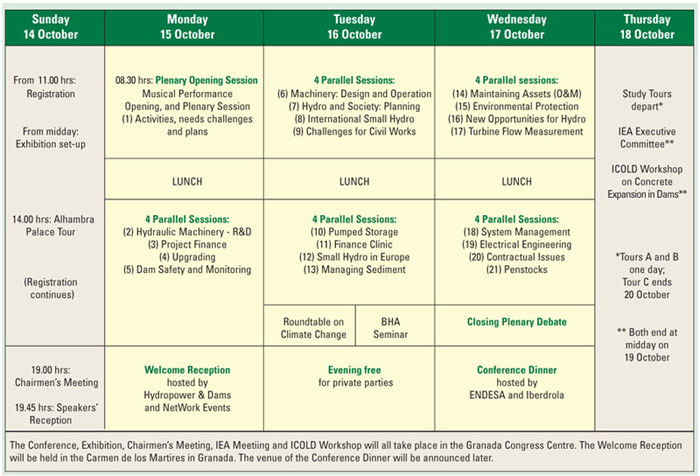
After a brief welcome, an extended plenary session on the first morning will allow all participants to benefit from issues which are important across the whole profession. As a foundation for the sessions to follow in parallel streams, Keynote addresses will introduce some of the most critical needs and challenges, as well as recent positive developments for hydro. Issues will include: capacity building, recent practical developments in project financing, and challenges for the design of water infrastructure. There will also be short country reports from Asian, African and Latin American nations with major development programmes underway and planned, to review progress and future plans.
The Conference will end with another plenary session, in the form of a debate where all delegates can participate. The programme will include more emphasis on marine energy (tidal, instream and wave power); developments in pumped storage; implications of climate change; capacity building; stakeholder involvement in planning; innovative technology; system management and operation; and challenging conditions for tunnelling at hydro sites.
We aim to bring together the best possible mix of experts from countries with hydro development programmes under way and planned (particularly those from the less developed countries with the greatest need for extra capacity), and those who can help them to achieve their aims (specialist consultants and suppliers, financiers, environmental and social scientists, etc). The Hydro Conferences represent constructive gatherings of those interested in advancing well planned hydropower schemes worldwide.
HYDRO 2007 in Granada will be the 14th in our annual series of Hydro Conferences, which have previously taken place in: Budapest (1994); Barcelona (1995); Lausanne (1996); Portoroz (1997); Aix en Provence (1998); Gmunden (1999); Berne (2000); Riva del Garda (2001); Kiris (2002); Dubrovnik (2003); Porto (2004); Villach (2005); and Porto Carras (2006).
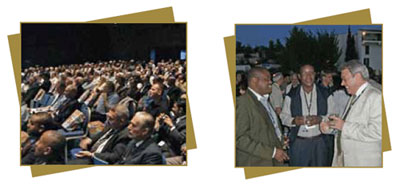
Attendance has steadily increased, and today these events attract around 750-800 participants from about 70 countries.
The greatest number of participants are developers, owners and operators. Also strongly represented are: planners, consultants, contractors, financiers, researchers, academic institutes, professional associations (national and international), manufacturers and suppliers. Last year, more than half of the 68 nations represented were African and Asian countries, with major development programmes in progress or ahead. This year a record number of abstracts were submitted for the programme, and it is already clear that many more countries will join us this year in Granada. If you are involved in the development or operation of large or small hydro or pumped-storage schemes, or dams for all purposes, you should plan to attend.
- Approximately 18 sessions on technical, financial, social and environmental aspects of hydro development, all with discussion periods included, provide the basic framework for the event.
- A number of special sessions and workshops are also being arranged to allow for discussions in more depth on some specific issues - see also side events below.
- A plenary debate on the final afternoon will encourage inter-action among all participants on some key issues and challenges.
- The Technical Exhibition will once again provide a platform for the most dynamic companies in the hydro profession – manufacturers, suppliers, consultants, contractors, research institutes.
- ICOLD’s Committee on Concrete is organizing a Workshop on Alkali Aggregate Reaction in Dams to follow the Conference.
- ESHA (the European Small Hydropower Association) will hold a Workshop on Small Hydro.
- IEC WG4, IGHEM and industry experts will host the Second Workshop on Turbine Flow Measurement. Building on the success of the First Workshop in Porto (2004) this will provide high level knowledge-sharing on the state-of-the-art of turbine flow measurement.
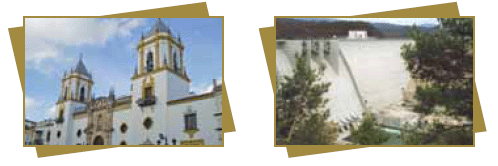
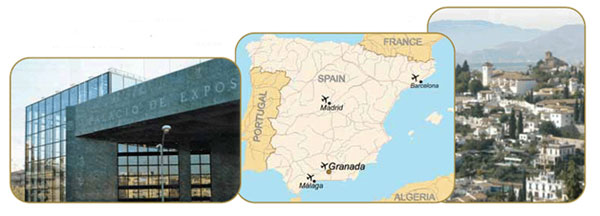
Rich in culture, history and natural beauty, Granada, in the province of Andalucia, southern Spain, is also surrounded by impressive multipurpose hydraulic works (some of which will be visited by HYDRO 2007 participants).
The spacious and elegant purpose-built Congress Centre, close to the Alhambra Palace, is well equipped for this major international Conference and Exhibition. It has formerly been the venue for meetings of ICOLD, ICID and the World Water Council. Hotels in all categories are available within walking distance of the Centre, and rooms have been arranged at favourable prices for HYDRO 2007 participants.
Some direct flights are available into Granada, and many more into nearby Malaga (from which shuttle buses will be provided - see registration form for more details). There are also frequent connections through Madrid and Barcelona.
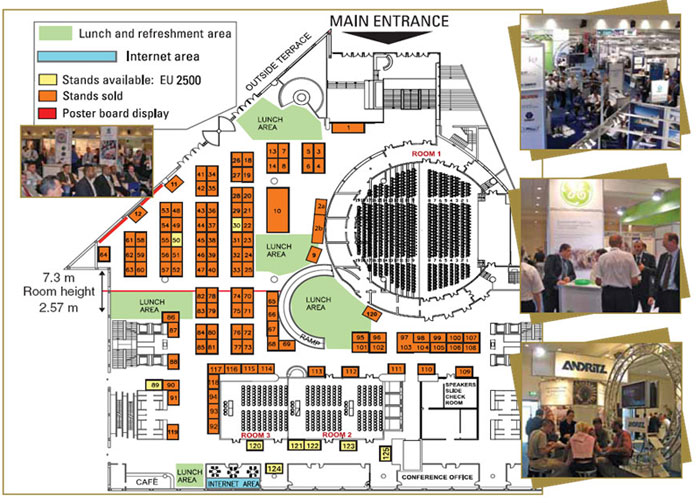
A major Technical Exhibition will take place alongside HYDRO 2007 ...
Buffet lunches will be served to all participants in the elegant and spacious Exhibition Area during the conference period, and all refreshment breaks will also take place there.
Exhibition space is sold in units of 6 m2, and includes panelling, a table, two chairs, spotlights, flooring and a company name sign.The price for one stand (6 m2) is Euro 2500.
Various opportunities will be available to sponsor social activities, such as apéritifs, lunches, receptions and coffee breaks.
This can be a pleasent and memorable way of bringing your organization to the attention of the international participants.
Granada, in the Spanish province of Andalucia, lies at the foot of the spectacular Sierra Nevada, Spain’s highest mountain range, and is also only 70 km from the southern coast. When the Andalusian poet Manual Machado tried to describe Granada in just four words, he chose the following: “secret water which cries”. This “secret” water is considered to be the soul of Granada, as it flows in small streams through the high peaks of the Sierra, feeding the land as well as fountains
and brooks (and also hydropower stations!).
One of the most brilliant jewels of universal architecture is the Alhambra, a series of palaces and gardens built under the Nazarene Dynasty in the 14th Century. This impressive compound of buildings, including the summer palace called Generalife, with its fountains and gardens, stands at the foot of the Sierra Nevada, and overlooks the city below and the fertile plain of Granada.
The hill facing the Alhambra is the old Moorish casbah or ‘medina’, known as the Albaicin, a fascinating labyrinth of narrow streets, cafés and whitewashed houses with secluded inner gardens, known as ‘cármenes’. The Plaza de San Nicolas, at the highest point of the Albaicin, is famous for its magnificent view of the Moorish palace.
Abstracts of up to 800 words, in English, are now invited on the themes listed or related topics. Please mail, fax or email abstracts to the address below. A short CV of each author should be included.
Your abstract should summarize precisely the scope and content of the paper proposed. No artwork or bibliography is required at this stage. In the case of any project described, please mention its current status or date of completion. If the abstract is sent by email, please incorporate the author’s name in the file name.
Please note: abstracts should only be submitted if the author would be able to attend the conference (or send a representative). Please obtain any necessary clearance, and check your availability to attend before submitting the abstract.
If the paper is accepted, you will be asked to sign a form confirming willingness to attend; it is essential that we receive this undertaking before allocating time for an oral presentation.
The deadline for receipt of abstracts is Friday 2 March 2007. Authors will be notified in April 2007 whether or not their paper has been accepted for presentation at the conference, or for publication in the Proceedings.
Abstracts will be reviewed by two or more experts on our International Steering Committee, and you may be asked to modify some aspects of your proposed paper. As this review process takes some time, we urge you to submit abstracts promptly (if possible well before the final deadline).
Full papers will be required by Friday 27 July 2007, and format guidelines will be sent to all authors whose papers are accepted. A hard copy and an electronic file of each final paper will be required.
Full details of the technical and social programmes, more information about the excursions, accommodation and registration fees, will be published in the Final Bulletin, which will be distributed by June 2007.