


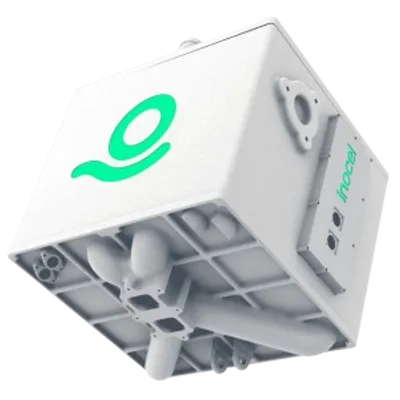
INOCEL - Model Z300 -300kW High Power Hydrogen Fuel Cell for Diverse Applications
The INOCEL Z300 fuel cell comprises cutting-edge technologies developed over 25 years by the French research institute CEA. The system is centered around the Z300 stack, known for its high-performance output exceeding 300 kW and featuring exceptional power density and rapid transient response, significantly reducing reliance on auxiliary batteries. The system integrates a stack, air and hydrogen lines, a duct system, and control elements, all enhanced by intelligent software for top-tier performance. Multiple innovations protected by 15 patents enable precise control of the electrochemical reactions within the fuel cell, optimizing its efficiency and durability. Its modular design suits a wide range of applications, including stationary power generation, maritime propulsion, and ground mobility, validating its adaptability to demanding environments. The Z300 stack promotes robust energy efficiency, achieving up to 60%, positioning it as a sustainable solution in clean energy technology.
Our fuel cell technology reflects our commitment to innovation and is built on 25 years of dedicated research and development efforts by the CEA, a top French research institute. Our fuel cell incorporates cutting-edge innovations protected by 15 patents, that continuously drive the evolution of our technology. These innovations encompass both hardware and software, providing us precise levels of control over our fuel cell’s performance, efficiency, and durability
At the heart of our cutting-edge fuel cell lies the versatile and high-performance Z300 stack, delivering over 300 kW with exceptional power density and rapid transient response, which significantly reduces the need for large auxiliary batteries.
Our product consists of key technological components, allowing us to precisely control the electrochemical reaction within the fuel cell, thereby optimizing its reliability and overall performance, positioning our technology at the forefront of the industry.
OUR CORE TECHNOLOGY:
Z300 CORE STACK
- Over 300 kW Gross Power Output,
- CE certified Solutions,
- Over 25 years of knowledge / + 15 patents,
- LT-PEMFC (High-end Temperature),
- Integrated Life Monitoring,
- Extensively Field Tested.
Understanding a fuel cell might seem taunting at first, but at the end, it is just a question of chemistry. The fuel cell mechanism is easy: convert chemical energy into electrical energy.
To solve this equation, the fuel cell is composed of two components, the bipolar plate, a key component in PEM fuel cells which diffuse gases, and a membrane electrode assembly (MEA). This MEA made of multiple layers, is composed with an electrolyte membrane and assembled on one side with a catalyst layer of anode, a oxidizing electrode that releases electrons, and on the other with a catalyst layer of cathode, a reducing electrode that acquires electrons. Hydrogen is injected in the fuel cell on the anode side while oxygen (from air) is passed through the cathode. Once the hydrogen reaches the catalyst layer in the MEA, the hydrogen molecules split into electrons and protons.
An important thing to keep in mind before moving on to the next step, is that protons are positive electrical charged particles, while electrons are negative charges. All electrical charges collected on the bipolar plate represent the available electrical energy.
The membrane has the role of electrolyte in the cell and allows only the protons to pass from the anode side to the cathode side. This means that the protons, once separated from their electron counterparts, are free to make their way through the membrane, while the electrons remain trapped on the anode side. For the atoms to be equalized, the meeting of both particles is crucial. The electrons are then forced through a different circuit to reconnect with the protons, and while these travel, the flow of electrons generates electricity and heat.
Once it reaches the cathode side, the electrons reconnect with the protons and with the injected oxygen producing water molecules (H2O) which are then ejected as waste from the fuel cell. This means that any type of machinery or transportation currently consuming gas to produce energy, could replace its combustion engine by a zero-emission, sustainable power source. A sign of hope for a decarbonized future.
Compactness
At equivalent volume and weight, INOCEL product more powerful than industry standard.
Further enables much smoother integration and dimensioning opportunities
Efficiency & Durability
INOCEL systems are designed to be both efficient and durable, and provides strong and market-leading efficiency of up to 58% to convert more energy into useful electric power than any combustion engine.
Our fuel cells have a lifespan at the highest standard of the market, making them cost-effective, reliable, and sustainable, which enables their widespread adoption as a clean energy technology.
Reactivity
The Z300 module can reach its peak power in under 2 seconds. It is currently the only PAC system that can serve as the primary source of energy generation, rather than functioning solely as a secondary element in hybrid systems.
As a result, our fuel cell systems require only minimal complementary hybridization, which in turn results in a smaller battery. This reduces costs, as well as the size, weight, and pollution of the system, making the INOCEL fuel system more efficient.
Modularity
From the outset, the INOCEL fuel cell system is designed for modularity with dedicated software management control to enable power generation of 300 kW to several MW making them scalable and suitable for meeting any power need.
Fuel cell module fully compliant with StasHH industry standards.
Embedded Software
INOCEL software developments of an advanced control system further enhance performance, efficiency & durability of our product.
Continuous over-the-air updates improve the product during its lifetime and offer monitoring for predictive maintenance.