


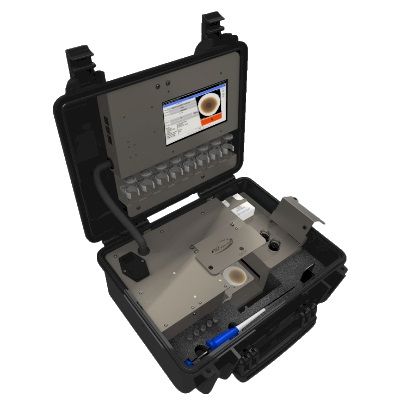
AD Systems - Model ST10 -On-Site Residual Fuel Compatibility Tester
Bulk fuel stored for long periods can become unstable the asphaltene content can precipitate out of solution causing the formation of sludge. This has the potential to block filters and pipes, leaving tanks with an unpumpable residue. The `break up` is dependent on the nature of the liquid hydrocarbons in which the asphaltenes are suspended. If the medium is aromatic (hydrocarbons in ring formation) then they will remain in suspension but if it is paraffinic (linear hydrocarbon formation) the asphaltenes may have a propensity to coalesce into sludge. Once a fuel has chemically broken down there is no way to satisfactorily reverse the process. Precipitated asphaltene cannot be re-dissolved. Stability, Cleanliness, Compatibility of Fuels, Fully Automated On-site Tester ASTM D4740. Patent(s): US Pat. N° 10 539 547 B2.
Although incompatibility is not a common phenomenon its likelihood increases in tandem with fuel switching, such as when entering and leaving an ECA. Compatibility problems must be treated as a critical concern as it can result in power failure, fuel systems can become paralyzed and the work for cleaning up the results is both difficult and time consuming. It is important to remember that a stable fuel oil can become unstable when mixed with another stable grade although generally fuels of the same viscosity grade with similar densities will be compatible.
The marine fuel market is undergoing complex and far-reaching change, largely as a result of a growing body of environmental legislation. Issues surrounding fuel cleanliness and compatibility have never been more relevant, especially with the new 0.10 per cent sulphur level for fuels used in Emission Control Areas (ECAs).
On board a vessel, a good way to measure the compatibility of marine fuels, including residual and distillate fuels, is the ASTM D4740 spot test. The ideal percentage mix is 50/50 as this is the worst case scenario.
A drop of the blend is put on a test paper and heated to 100°C. After 1 hour, the test paper is removed from the oven and the resultant spot is examined for evidence of precipitation and rated for compatibility against D4740 reference spots.
AD Systems has developed a portable / on-site / on-board fully automated instrument for cleanliness and compatibility testing of heavy fuel oil. This portable device is a complete automation of the ASTM D4740 method.
This method is very simple and practical for the test but it had the serious handicap to rely on the know-how and subjectivity of the operator.
We have grouped all the phases of the test in a suitcase, the conditioning of the samples, and the preparation of the spot, its drying and the automatic rating by camera and associated software.
The only phases under the load of the operator are the sampling and the deposition of the drop with the aid of a micropipette supplied with the equipment.
As a result, the apparatus can be used anywhere by untrained persons for this test whenever power is available.
The apparatus is provided with a database for storing the results. The image of the spot is memorized at the time the spot is rated and we therefore ensure perfect traceability of the test.
- Marine
- Refineries
- A complete automated system self-contained in a carrying case
- Multi-applications instrument, lab, on-site, on-board
- Vessel operators
- Refineries
- Terminals
- Power plants
- Independent laboratories
- Military
- Standard test method used by conventional laboratories.
- Fully automated, no training or analytical knowledge required
- Removes subjectivity
- Prevent sludge deposits, failure of fuel handling systems and costly combustion related engine damage.
- No solvents
- Quick and reliable determination.
- Designed for both on-board use and lab use.
- Full traceability with built-in database
- The operator keys in all information related to the sample and the test conditions
- The fuel or the mixed fuel is poured into a disposable vial and then placed into the built-in oven.
- The filter paper is positioned on the conveyor. The ST10 automatically places the filter paper in the oven for drying at 100°C.
- The operator is prompted when the sample temperature is reached and the filter paper is pre-positionedfor sampleinjection.
- With the micropipette, the operator pours one drop of fuel on the filter paper.
- The fuel spot is automatically positioned in the oven at 100°C.
- After the drying phase, the fuel spot is automatically moved under the camera and a picture is captured.
- The software analyses the fuel spot.
- The test result is displayed and stored in a built-in database.
The test result is displayed and saved in the built-in database with all test conditions including the spot image.
List of parameters saved with a result :
- Sample type(s)
- Sample ID(s)
- ASTM D4740 rating (from 1 to 5)
- Date & time
- Operator name
- Comments
- Test conditions
- Calibration information (tube serial number + date of calibration)
- Instrument serial number
- Software version
The results can be displayed, memorized on a USB disk on key or send to a LIMS via the LAN connection.
Reported Results: Measurement Range
- ASTM D4740 rating: From 1 to 5
- Accuracy: Less than one rating
- Test mode:
- Programmable:
- Fuel Cleanliness
- Fuel Compatibility
Technical Specification: Description
- Display:
- 7" Touchscreen
- Screen size : 155mm x 86mm
- Resolution : 800 x 480 px
- Oven temperature:
- 100°C for the filter paper
- 93°C for the fuel
- Resolution 1°C
- Sample heating time: According to D4740 or programmable in minutes
- Oil spot drying time: According to D4740 or programmable in minutes
- Parameters saved with a test result:
- Cleanliness or Compatibility (1 to 5)
- Fuel spot image
- Test mode
- Fuel heating time
- Spot drying time
- Sample type
- Sample ID
- Date & Time
- Operator Name
- Comments
- Software version
- Results storage: Up to 100 000 results
- Data output: Local display, export to USB
- Dimensions:
- W x D x H (mm): W x D x H (inches)
- 420 x 350 x 220 : 16.5"x 14"x 8.5"
- Weight: 11 kg (24 lbs)
- Electrical: 115 to 230V - 2A - 50/60Hz