


- Home
- Companies
- Hebei Tongke Electrical Appliance ...
- Products
- TONGKE - Aluminum Oxide Coloring Power ...
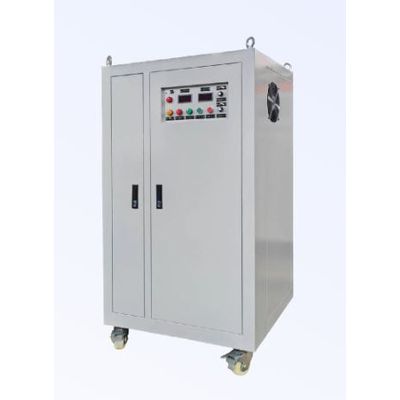
TONGKE - Aluminum Oxide Coloring Power Supply
Aluminum oxidation power supply, also known as high-frequency aluminum oxidation power supply or aluminum profile oxidation power supply, is a specific term for the application of oxidation power supply on aluminum profiles
Aluminum oxidation power supply, also known as high-frequency aluminum oxidation power supply or aluminum profile oxidation power supply, is a specific term for the application of oxidation power supply on aluminum profiles. This power supply adopts the new generation of high-frequency switching power supply technology and IGBT power control module, making it an ideal power supply equipment to replace the old generation of oil cooled thyristor rectifiers. It has the advantages of energy conservation, sustainable working time, and strong corrosion resistance. It adopts an air-cooled remote control mode, which is convenient for equipment maintenance and repair. Capable of outputting high-power current and voltage, meeting the power configuration requirements of the new generation aluminum oxidation process and large-scale aluminum oxidation production.
- Reducing porosity, the formation rate of crystal nuclei is faster than the growth rate, promoting the refinement of crystal nuclei.
- Improving the bonding strength, causing the passivation film to breakthrough, is conducive to a strong bonding between the substrate and the coating.
- It has functions such as voltage regulation (constant voltage), current regulation (constant current), soft start, phase loss protection, overvoltage/undervoltage protection, overcurrent protection, overheating protection, etc., ensuring safety issues.
- Ensure significant improvements in the uniformity density, wear resistance, and decorative properties of the oxide film.
- Reduce the internal stress of the coating, improve lattice defects, impurities, voids, tumors, etc., easily obtain a crack free coating, and reduce additives.
- Beneficial for obtaining alloy coatings with stable composition.
- Improve the dissolution of the anode without the need for an anode activator.
- Improving the mechanical and physical properties of the coating, such as increasing density to reduce surface and body resistance, improving toughness, wear resistance, corrosion resistance, and controlling the hardness of the coating.