

Antifrogen - Model SOL HT -Solar Heat Transfer Fluids
Today’s energy efficient solar water heating systems maintain extreme heat loads, and require a heat transfer fluid that does not evaporate and provides proven frost protection without any phase separation in water. Antifrogen SOL HT was designed specifically for the demands of evacuated-tube collectors with stagnation temperatures that can reach 260°C (+500°F). Antifrogen SOL HT, developed by Clariant Corporation, contains several corrosion inhibitors that protect the metals of the solar system against corrosion and boiler scale formation.
How Solar Heat Transfer Fluids Work
To heat water using solar energy, there are three basic collection methods depending on climate, expense and efficiency:
- Flat-plate: The most common type, basically an insulated, weather proof box with a dark absorbing plate to warm the water that passes through it.
- Concentrating collector: Involves a parabolic mirrored surface that concentrates the solar energy on a absorber tube containing heat transfer fluid.
- Evacuated-tube collector: Contains rows of parallel glass vacuum tubes designed to transfer the solar energy through the heat transfer fluid into an insulated hot water storage tank. The heat transfer fluid (HTF) for the absorber is a separate loop of fluid containing anti-freeze and a corrosion inhibitor which delivers heat to the tank through a heat exchanger (commonly a coil of copper tubing within the tank).
- Non toxic, higher glycols with anticorrosion additives
- Premixed and ready to use
- Suitable in any thermal solar collector
- No phosphates or nitrites in the corrosion inhibitor formulation
- Harmless to health
- No Phase separation
- Consistent Frost resistance, provided the concentration remains constant
- No flash point or ignition point
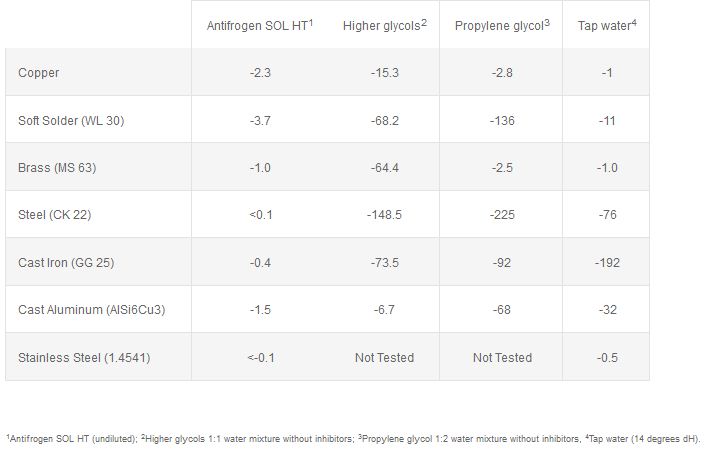
The following table shows the relatively low corrosion of common metals caused by an Antifrogen SOL HT compared with water and cooling brine. The values, determined by the above mentioned ASTM method, show the weight loss of metals in g/m² due to corrosion.
Corrosion of metals in g/m², tested in accordance with ASTM D 1384 (336 h/88 °C/(190.4°F), 6 l air/h)