

AZURA - Absorber Wave Energy Converter
Azura is a multi-mode, point absorber wave energy converter developed to target the growing international market for utility scale renewable generation. Unlike other wave energy converters, Azura extracts power from both the heave (vertical) and surge (horizontal) motions of waves to maximize energy capture. The system produces power as a result of the relative rotational motion between the hull and float. The power takeoff (PTO) system is based on high pressure hydraulics and is located within the PowerPod.
Our technology uniqueness not only comes from it’s tested and proved rugged robustness in the harshest environment on the planet, but in its dual capabilities to supply both ENERGY and / or WATER from the device. An in-house developed Hydraulic Drive System (HDS) technology has resulted in the adaption of a commercially proved desalination system to be placed on-board. Continuous potable water can now be produced to ensure the site or community have an ongoing supply of water.
AZURA’s modular design has allowed the ability to build to meet both a client’s or community requirements, but also that of the deployment site conditions
A key feature of the Azura design is that the float can rotate continuously and oscillate back and forth, which enables the device to extract energy in a wide variety of wave conditions and improves the overall efficiency of the system. The fully rotating float also provides a self-limiting power shedding effect, which makes the device inherently survivable in open ocean environments and helps to reduce loads in the mooring system. Another benefit of the Azura design is the very low reserve buoyancy, which allows it to partially submerge under large waves.
Since concept and initial development in 2006, the Azura technology has advanced from initial concept (TRL 1) and micro-scale modeling stage (TRL 3) to open ocean testing of large scale prototypes (TRL 5/6). Under the R&D program implemented in New Zealand, three prototypes were deployed for open-ocean testing, including a TRL 5/6 prototype deployed near Christchurch, NZ.
The Oregon prototype was fabricated, deployed and tested in 2012 in the open ocean at the NNMREC wave energy test site off the coast of Newport, OR. This marked the first successful deployment of a TRL 5/6 wave energy device in Oregon and first device to be connected to NNMREC’s instrumentation buoy, the Ocean Sentinel. More than 30 million pieces of data were collected which were analyzed and formed the basis of the TRL 7/8 or first commercial scale design. Learn more about the Oregon Pilot project.
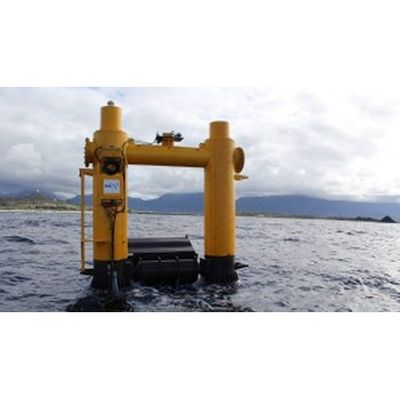
In September 2012, the project was selected by the DOE and the US Navy via a competitive process to AZURA Prototype Hawaii Deployment 1 modify and redeploy the prototype at the Navy’s Wave Energy Test Site (“WETS”) located at the Marine Corps Base Hawai’i (“MCBH”). The Navy had been evaluating Ocean Power Technologies’ (“OPT”) PowerBuoy technology at the WETS site since 2003. However, the OPT device has been removed and the Navy is now working with the Azura team to evaluate Azura as a cost-effective and secure means to supply power to their bases.
Azura was initially deplpoyed at WETS in June 2015 where Azura was successfully connected to Hawaii’s power grid and became the first grid connected wave energy device in North America. During this initial 18-month deployment Azura achieved 98% availability and continued to produce with no damage through a 7.5-meter wave height hurricane. Independent third party validation and monitoring was undertaken by the University of Hawaii to ensure high level specialised analysis to assist in system refinement and optimisation.
Key outcomes from WETS deployment #1
- Device modified after analysis and review of data from initial deployment:
- New float configuration
- Introduction of heave plate
- Further 6-month deployment. (Deployment#2)
- Data validated with WECSim model for development of commercial scale design.
The PowerPod converts the heave and surge motion of the wave into useful electricity. Two hydraulic cylinders which are driven by the eccentric shaft are located in the lower legs of the PowerPod in a flooded compartment. High pressure flow lines penetrate the bulkhead between the dry and wet portions of the PowerPod. All other components of the power take-off system are located in the upper horizontal member of the PowerPod. As the force of an approaching wave causes the float to rotate and the hull to heave and surge, the crankshaft drives the hydraulic cylinders. The pressure from the cylinders is accumulated and then used to drive a variable displacement hydraulic motor, which in turn drives an electrical generator, producing variable frequency alternating current.
The movement of the waves produce relative rotational motion between the hull and float.
Unlike other wave energy converters, Azura extracts power from both the heave (vertical) and surge (horizontal) motions of waves to maximize energy capture.
Such motion avoids “hard endpoints” making it less prone to conventional wear and tear.
Azura’s desalination systems are to be offered in two permutations.
A: Potable water only for customers with water supply priority.
B: Power in combination with water.
Often areas requiring potable water (apart from mainland areas)additionally have limited or unreliable power supply resources.
This gives the Azura flexibility in meeting different customer requirements
Azura’s desalination units integrate proven Parker Reverse Osmosis technology with a new hybrid hydraulic drive system (HDS). Azura drives this process directly from wave energy – with no intermediary conversion to electricity required – thus significantly raising production efficiency by minimising loss. This is a first for the water purification industry and unique to Azura
The desalination device can be deployed in locations with low fresh water resources be it ongoing or emergency. The required locations for the desalination product have been identified as:
- Small islands with limited fresh water resources.
- Island communities experiencing rising salinity in their water tables
- Mainland communities facing drought
- Offshore installations
- Natural disaster relief