


- Home
- Companies
- Quantel Pte Ltd
- Products
- Quante Chroma - Model ATE 8610 - ...
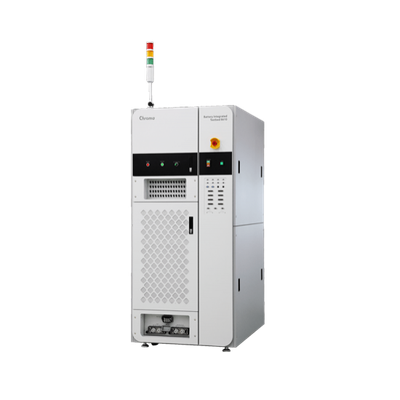
Quante Chroma - Model ATE 8610 -Battery Pack Integrated Testbed
The Chroma ATE 8610 is a sophisticated testbed designed to evaluate new energy vehicle battery systems and their components, including battery modules and management systems. Equipped with various hardware integrations like DC power supplies, chargers, digital meters, and safety devices, it provides a comprehensive testing environment. When combined with Chroma's 17040 Regenerative Battery Pack Test System, the 8610 can simulate real-world driving conditions for enhanced test accuracy. It supports R&D of battery modules with an open software architecture facilitating dynamic test item implementation. The testbed's advanced features, such as vehicle driving cycle import, CAN signal monitoring, and fault injection, allow for testing in complex scenarios. By facilitating early detection and correction of issues, it helps in reducing development costs and boosting test efficiency. It is integral to the vehicle's standard V-shape development process, simulating various scenarios before actual vehicle testing.
Chroma ATE launches the 8610 Battery Pack Integrated Testbed for testing new energy vehicle battery systems and their subparts, including battery modules, battery management systems, cooling/heating systems, and other related components. Various hardware options are available for integration, such as DC power supply, battery charger/discharge system, digital meter, insulation measurement equipment, and short circuit and overvoltage protection devices.
The 8610 system integrated with Chroma’s 17040 Regenerative Battery Pack Test System can simulate the charging and discharging of battery pack using the power system under various driving conditions to increase the test reliability when testing a whole vehicle.
The 8610 Battery Pack Integrated Testbed is designed for research and development of battery modules and packs. The open software architecture offers users powerful dynamics and flexibility while implementing various test items. Besides basic functions like vehicle driving cycle import, CAN signal monitoring, fault injection, insulation measurement, and EVSE charging simulation, this testbed can execute the most complex scenarios of a real vehicle and composite operation conditions with the highest risk of failure (e.g. physical and communication signal errors during cyclic discharge).
The 8610 highly supports the testing requirements on the right side of the vehicle’s standard development, V-shape process, from the integration of battery pack components to the system-level functions. This testbed system can implement various composite and simulated vehicle scenarios in advance before entering a real vehicle test. Users can also discover and correct problems early to reduce development costs and improve test efficiency.
- Support upper-level automated test software through ASAM XIL and ASAM XIL-MA
- Extensive modular hardware to fulfill test accuracy and repeatability; expandable according to users’ needs
- Support CAN, CAN FD, and LIN communication interfaces
- Independent PLC real-time monitoring to ensure safety during battery pack charging and discharging tests
- Built-in AC/DC EVSE charge interfaces, including CAN Bus and PLC communication and related control signals for GB/T, CHAdeMO, and CCS compatibility tests
- Real-time monitoring of timing sequences, including high power relay open/close, initial power output, and CAN signals
- Integrated with Fault Injection Unit to combine fault signals and simulate fault injection
- Support Altair Activate and various Simulink-based real-time models for import to simulate on-road test conditions
- Integrated with Hipot safety analyzer to measure and compare battery insulation and grounding status
- Battery pack calibration and verification
- Reliability and durability tests
- Simulation of vehicle driving conditions
- System integration tests