


The use of biochar is an effective strategy to improve soil fertility, increase fertilizer efficiency, promote healthy plant growth, and contribute to agricultural sustainability in the context of climate change and the growing demand for food. We will detail this idea now.
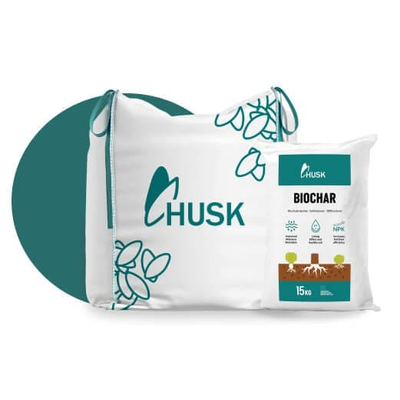
HUSK Biochar is produced from organic rice husks and complies with the highest standard for biochar agricultural use: the EBC-Agro Organic standard, ensuring its quality, its compliance with EU fertilizer requirements (EU 2029/1009 CMC 14), and its suitability for organic production. It can be applied independently or mixed with nutrients (EMs, compost, macronutrients, etc) to produce premium fertilizers.
Need:
Retain moisture and nutrients or regenerate degraded soils.
HUSK product:
BIOCHAR
How it works:
Acts like a sponge due to it´s high porosity. Speeds up composting, increases the adsorption of nutrients contained in fertilizers, improves soil structure and boosts microbial activity.
- Water holding capacity increase*
- Slow release nutrients and minerals. Increased fertilizer efficiency
- Liming effect (pH 8 to 9)
- Increases cation-exchange capacity
- Stronger leaves and healthier crops
- Provides optimal aeration for beneficial microbial growth
- Improves soil structure, reduces compaction
- Improved yields from first application**
*Scientific published literature suggests an increase of 50% water holding capacity over unamended soil.
** Our results in Cambodia show an average of 26% increase in crop yields which means higher revenues for farmers as well as a reduction in chemical fertilizers and pesticides and irrigation costs.
Allowing for high stability in the soil (<100 years) and improving its fertility. Additionally, it enables the formation of stable aggregates in the soil, reducing greenhouse gas emissions and serving as food for microorganisms.
By absorbing and retaining heavy metals and organic compounds in its porous structure, biochar prevents them from contaminating groundwater.
The application of biochar reduces methane (CH4) and nitrous oxide (N2O) emissions by decreasing fertilizer losses in the soil, thereby reducing nitrous oxide formation and emission.
Activate HUSK biochar before incorporating it into the soil to ensure it loads and absorbs nutrients before releasing them to the plants.
For particularly beneficial effects, biochar should be applied at dosages ranging from 10% to 15% by volume, with compost or other organic substances before applying into the soil.
- For seedlings or pots: add around 15%-20% by volume.
- For vegetables: apply dosages between 0.5 kg/m² and 1 kg/m².
- For trees and fruit trees: use between 1 kg and 2 kg depending on the plant`s size.
We can provide Biochar in two different formats: 20 kg bags and big bags (400 kg/m3).