


- Home
- Companies
- Martin GmbH für Umwelt- und ...
- Products
- Martin - Bottom Ash Discharger
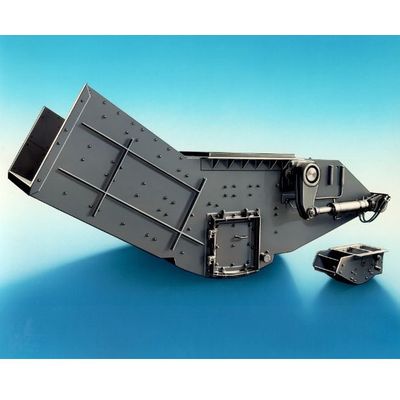
Martin - Bottom Ash Discharger
For decades, the MARTIN discharger has proven to be a compact, reliable and cost-effective device. The hot, burnt-out bottom ash is transported from the grate end to the discharger`s water bath where complete quenching occurs. The water consumption depends exclusively on the temperature of the bottom ash and its capacity to absorb water. Only sufficient water to quench the bottom ash is fed to the discharger. Neither a water overflow nor recirculation is required and the area around the discharger remains clean.
The basic design is the same for all dischargers. They are all filled with water and a constant amount of bottom ash up to the level of the front air sealing wall. This creates an air seal against the furnace, thus preventing flue gas and thermal pollution in the discharger area on the one hand and false air ingress into the furnace on the other.
The discharging ram pushes the bottom ash under the air sealing wall towards the drop-off edge. As a result, the bottom ash is discharged in a dust-free and odourless manner. There is a drain-off section before the drop-off edge where excess water is extracted by the compressing action of the discharging ram. The bottom ash is therefore moist rather than wet when discharged.
The wear plates, liner plates and wear strips on the discharging ram in the MARTIN discharger are replaceable. The discharger is driven either by a separate or by a central hydraulic unit.
A wide range of dischargers is available, the smallest with a discharging capacity of approx. 0.2 m3/h. Dischargers for coal-based combustion systems have a discharging capacity of approx. 0.4 to 3.0 m3/h. Discharging capacities for waste combustion plants range between approx. 4.5 and 12.0 m3/h.