


- Home
- Companies
- Central Station Steam Company
- Products
- Cadillac - Model CMASS - Energy Meter
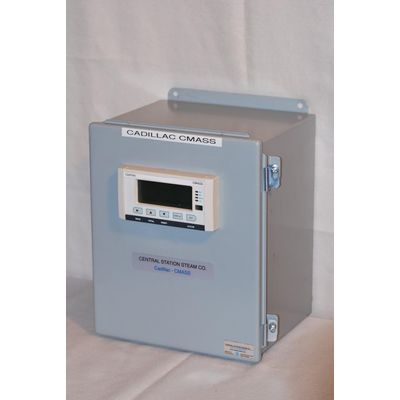
Cadillac - Model CMASS -Energy Meter
The Cadillac CMASS Mass Flow / Energy systems are designed to measure the energy consumed in Super-Heated Steam and Natural Gas applications. The system is a rate and totalizing device, which is capable of calculating and displaying Volume, Volume Flow rate, Corrected Volume, Corrected Flow rate, (Heat & Heat Flow rate in Natural Gas), Mass, Mass Flow rate, (Energy in Steam) , Temperature, Pressure, (Compressibility Factor in Natural Gas), and (Specific Volume & Enthalpy in Steam). Combined with Cadillac®’s superior flow meter technologies the CMASS provides the most accurate, repeatable, and maintenance free Mass Flow / Energy system available in the industry.
The Cadillac® HEATX CMASS Mass flow / Energy meter measures the Volumetric flow via a Cadillac® CV-P, CV-HS, or CV-U Vortex flow meter along with temperature and pressure inputs via separate loop powered transmitters and in turn calculates the Mass flow and Energy of the compressible media (Gas or Superheated Steam) being measured using internal calculations specific to either Steam (IAPWS industrial formulation) or Natural Gas (SGERG AGA-8 Gross equations).
The New Industry Standard
Combined with Cadillac®’s superior flow meter technologies the CMASS Mass Flow / Energy meter has quickly become acknowledged as the industry standard. Customers choose the Cadillac® CMASS Mass Flow / Energy Meter because of proven: Accuracy, dependability, consistency, low maintenance, reliability, and rangeability.
Cadillac® Energy CMASS Meter – Applications
The Cadillac® Energy CMASS Meter is the meter of choice for energy applications. This meter can be applied effectively for the following purposes:
- Energy consumption data source for energy management system, DCS, district-wide systems.
- Energy-Customer Billing from accurately totalized Energy / Mass Flow measurements.
- Basis for internal cost distribution using campus-wide systems.
- Efficiency measuring and monitoring from central control rooms.
- Direct Energy / Mass Flow measurements at both Boiler and point of use locations.
Cadillac® Energy CMASS Meter – Features
The Cadillac® Energy CMASS Meter is the meter of choice for energy applications. This meter contains the following features:
- Natural Gas Flow: Measures the volume, mass, and gross heat content of natural gas by using analog inputs; volume flow, temperature, and pressure.
- Super-Heated Steam Flow: Measures the volume, mass, and energy content of Super-heated steam by using analog inputs; volume flow, temperature, and pressure.
The Cadillac® CMASS BTU / Energy Meter operate differently for gas and heat applications.
CMASS Super Heat Steam
for calculating Mass flow or Energy according to the IAPWS industrial formulation (1997) for the thermodynamic properties of steam. The equations use the pressure and temperature values to determine the specific volume and the specific enthalpy.
Formulas:
- Mass Flow = Volume flow/ Specific volume
- Energy flow = Mass flow x Specific enthalpy measures the temperature in the feed and return lines via two precision matched 4-wire RTD’s and from this calculates the density and enthalpy of the water. In addition, by also measuring the volume of water flowing in the system via the Cadillac® flow meter, the HEATX will then compute, display, and output the Energy consumed.
CMASS Natural Gas
For calculating the gas density and compressibility factor based on the SGERG (AGA-8 Gross) equations. The equation uses the pressure and temperature values to determine the Mass flow, Corrected flow, and Heat flow.
Formulas:
Mass Flow = Volume flow x pflow Corrected flow = Mass flow x pref Heat Flow = Mass flow x Hm Where:
pflow = Density at flow conditions pref = Density at reference conditions Hm = Mass gross heating value
Power is Calculated:
- P = V x p x (htv-htr)
Where:
- P = Power (watts)
- V = Volumetric flow Rate
- p = Density
- htv = Specific enthalpy at Feed temperature
- htr = Specific enthalpy at Return temperature