


- Home
- Companies
- Franklin Electric Grid Solutions
- Products
- CELLGUARD - Wireless Battery Monitoring ...
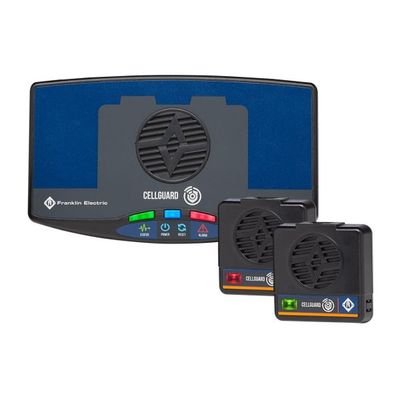
CELLGUARD - Wireless Battery Monitoring System (BMS)
The CELLGUARD™ Wireless Battery Monitoring System (BMS) provides an accurate and reliable indication of battery state-of-health through monitoring and analysis of battery voltage, temperature, and conductance.
Get remote access to the information you need to proactively maintain your stationary power systems and avoid costly downtime. With solid noise immunity, the CELLGUARD™ Wireless Battery Monitoring System is suited for applications including power utilities, data centers, telecommunications systems, and DC systems with filtered AC electrical ripple.
WIRELESS COMMUNICATION
Installation cost and time are reduced with the system’s wireless communication capabilities which enable all hardware to communicate to the Base controller free of cabling.
ACCURATE CONDUCTANCE MONITORING
Conductance-based monitoring technology provides the most accurate, efficient, and non-invasive method possible for monitoring a battery’s state-of-health.
ADVANCED HARDWARE
Comprised of a Base Coordinator Unit (BCU) and single-battery sensor modules, the system provides both visual and digital battery state-of-health and is capable of monitoring up to 16 battery strings, up to 300 sensors per string, and up to 600 sensors per BCU (irrespective of how they are divided by strings).
CUTTING-EDGE WEB INTERFACE
The highly intuitive CONVERGE™ web interface enables rapid, confident installation, remote system monitoring, alarm threshold configuration, rock-solid reporting (including granular discharge data gathering), and critical over-the-air sensor firmware updates.
Specifications
Component : Specification
- Battery Strings : 1-16
- Batteries per String : 1-300
- Battery Voltage Test Interval Range : 1 – 24 hrs
- Battery Conductance Test Interval Range : 1 – 30 days
- Power Input : 9-12VDC @ 800mA
- Operating Temperature : 0°C - 65°C
- Storage Temperature : -10°C - 80°C
- Processor : Quad Core @ 1250MHz
- RAM : 1Gb SDRAM @ 400Mhz
- Storage : 4GB micro SD card
- 4 X USB Type A : 2.0
- UART : Baud Rate: 57.6Kbps; Data Bits: 8; Parity Bit: None; Stop Bit: 1
- Ethernet : RJ45; 10/100Mbps; Auto-Negotiate; 802.3 Compliant
- Analog Alarm Input : 0.2-10 V differential
- Binary Alarm Input : Dry Contact
- Major/Minor Alarm Output : Form C Relay 110 VDC 125 VAC max
- Wireless RF Radio Band : 802.15.4 compliant; 2.4 GHz @ 8mW (6.3dBm)
- Modbus : Ethernet TCP/IP UDP
- Regulatory Compliance : FCC, CE, RoHS, IEEE
- Physical Dimensions :L:7.80in, W:4.47in, H:1.44in
Capabilities
- Supports up to 16 strings with 300 batteries per string
- Supports up to 600 sensors per BCU (irrespective of how they are divided by strings)
- Examples of BCU String Configurations:
- If 60 cells per string, then the max is 10 strings (60 x 10 = 600)
- If 4 batteries per string, then the max is 16 strings (4 x 16 = 64)
- If 24 cells per string, then the max is 16 strings (24 x 16 = 384)
- If 240 cells per string, then the max is 2 strings (240 x 2 = 480)
- Network communications
- DNP3 Communications
- Embedded Internal Web Server
- Field upgradable software
- Two ambient temperature sensors
- String voltage capture (Sum of Batteries)
- Discharge data collection and reporting
- Remote network configuration
- Field hardware commissioning
- External Alarm Dry Contacts – Utilized with ELS System
- Capture string and battery data, reports to CELLTRAQ™ Battery Management Software at scheduled frequency