


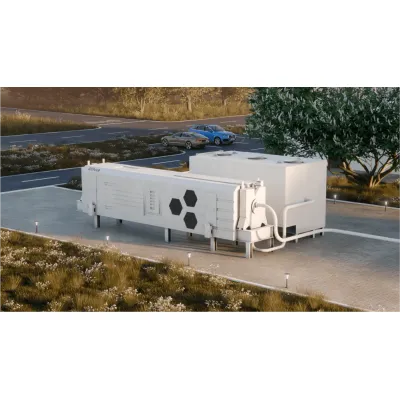
A century-old technology, reimagined
Fluidised bed systems have been used for decades in the food and pharmaceutical industries for applications as varied as drying spices and applying coatings to medicines.
Fluidised beds take advantage of a physical phenomenon called fluidisation, which takes place when solids pushed upward by a gas or liquid take on the properties of a fluid, like sand in a sandstorm or small pebbles in river rapids.
Airhive began experimenting with fluidised bed systems for DAC because we saw the potential that atmospheric air and our mineral sorbent might react more quickly if the sorbent was bubbled up through the air.
Promising initial results led the Airhive team to redesign fluidised beds for DAC. Our partners began producing these systems in 2024.
Our DAC systems use natural minerals that chemically bind the carbon dioxide from the air, then unbind it in a pure form for sequestration or utilisation. This process happens in three distinct phases.
Phase 1
Capture
Air is driven through the sorbent material in our system at high speed, creating a sandstorm-like phenomenon in which carbon dioxide molecules rapidly collide with the sorbent particles. This turbulence transforms the carbon-absorbing material into small particles with high surface areas, significantly enhancing their capacity to capture CO₂.
The process is nearly instantaneous, capturing most of the CO₂ in the air that passes through in less than a second, and 99% of the CO₂ in ideal conditions. The continual mixing of particles and air maintains this high capture efficiency throughout the capture process.
Phase 2
Regeneration
The sorbent material is electrically heated until the CO₂ is chemically unbound from the sorbent. This releases a pure stream of CO₂, which will be further processed in the DAC system, while regenerating the sorbent for repeated use in the capture phase. Since our system is fully electrified, 100% renewable energy can be used to power this process.
Phase 3
Sequestration and utilisation
The pure stream of CO₂ is then processed and transported to its final destination. This could be a geological storage reservoir, where the CO₂ is locked away for millennia, or a product where it serves as an essential ingredient, such as in sustainable fuels, food and beverages, or a range of novel materials.