


- Home
- Companies
- The Motwane Manufacturing Company Pvt. ...
- Products
- Motwane - Digital Earth Tester
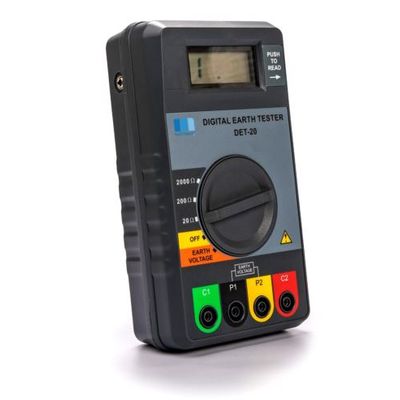
Motwane - Digital Earth Tester
DET 20 is a conventional 3 ½ digits LCD designed to measure earth resistance, soil resistivity & earth voltage. It has a unique RSR technology in which the measurement reading remains constant even when the battery voltage drops. DET 20 has a 128Hz test frequency that eliminates the harmonics interference and has a rechargeable long-life battery which reduces costs. Earth resistance is measured by three wires & soil resistivity is measured by four-wire measurement techniques. This meter is shockproof and dustproof and comes with an ABS casing for heavy duty application. DET 20 is type tested as per IS 9223.
Application
The integrity of the grounding system is very important in an electrical power system for the following reasons:
To maintain a reference point of potential (ground) for equipment and personnel safety
To provide a discharge point for traveling waves due to lightning
To prevent excessive high voltage due to induced voltages on the power system
Therefore to maintain sufficient low resistance values of grounding systems, periodic testing is required. The testing involves measurement to ensure that they do not exceed design limits.
The measurement of ground resistances can be accomplished with specially designed test equipment. The most common method for measuring ground resistance is the fall-of-potential principle of alternating current (AC) at a higher frequency circulating between an auxiliary electrode and the ground electrode under test. The reading will be given in ohms and represents the resistance of the ground electrode to the surrounding earth.
Soil resistivity is also a key factor that determines what the resistance of a grounding electrode will be, and how deep it must be driven to obtain low ground resistance. The resistivity of the soil varies widely throughout the world and changes seasonally. Soil resistivity is determined largely by its content of electrolytes, consisting of moisture, minerals, and dissolved salts. Dry soil has high resistivity if it contains no soluble salts. The figures have a direct impact on the overall substation resistance and how much earth electrode is required to achieve the desired values. The lower the resistivity the fewer the electrodes required to achieve the desired earth resistance value. Hence soil resistivity is also an important test.
The methods of measuring and testing the ground resistance and soil resistivity are as follows:
3 pole method used for earth resistance testing
4 pole method used for soil resistivity testing.
Typically used for
- Substation earth testing
- To test telecom tower grounding and railways earthing
- To test the quality of grounding without disconnecting the ground rod under test
- Earth resistance of the grid
Features
- 3 ½ digits LCD display with a maximum reading of up to 1999
- 3 terminal and 4 terminal measurement method
- Earth resistance range from 0.01? to 1999?
- 4 soil resistivity measurement
- Rechargeable internal Ni-MH battery
- Earth measurement voltage of up to 200V
- Ratiometric synchronous rectification
Earth Resistance Ranges
- 0.01?to 19.99?
- 0.1?to 199.9?
- 1?to 1999?
Accuracy (25° C ±5°C)
- ±1.5% of reading ±5 digits valid from 10% to 95% of the range.
- Earth voltage accuracy: 2% of the range
- Earth voltage resolution: 1V
- Test Frequency: 128Hz ±0.5Hz
Test Current
- 20 ? Range: 10mA AC RMS
- 200 ? Range: 1mA AC RMS
- 2000 ? Range: 100µA AC RMS
- Test current is generally constant throughout the range
- Power Supply: Internal, rechargeable Ni-MH 1.2V, 600mAh x 8nos.
- Charging time: Recommended 16hrs.
- Single Charge Battery life: Approximately 5-6hrs of continuous operation on mid-range.
- Interference
- Interference voltage of 20V ±5% peak to peak, 50Hz in the potential circuit will
- have a maximum effect ±1% on the reading obtained from the 20 ? to 2K? range.
Influence of Temperature:
- <±0.2% per °C over the temperature range 0-20°C and 28-55°C.
Temperature Range
- Operating : 0°C to +55°C <90% RH
- Storage : -20°C to +70°C <90% RH
Humidity
- Operating : 95% RH non condensing max at 40 °C
- Storage : 93% RH non condensing max at 55 °C
- Flash Test : 2KV AC
Voltage withstand
- In the event of a system fault, the instrument will withstand 240V AC, applied between any two terminals.
- Dimensions : 180(H) x 100 (W) x54 (D) mm
- Wight : 550gms without accessories
Standard Accessories
- 4nos. spike of 10mm dis, 450mm long
- 10m, 20, 30m &40m of measurement cable on a winder as standard
- Battery charger
- Hammer
- Carry bag
- Instruction manual