

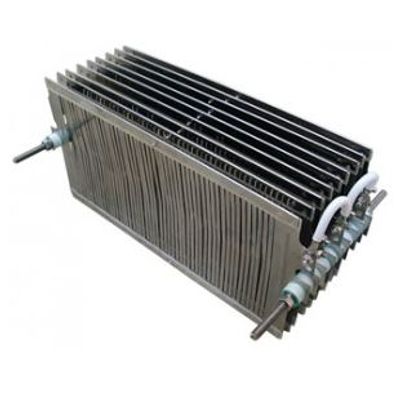
Neutral Earthing Resistors (NERs) are one of the commonest types of earthing systems in medium-voltage AC distribution networks. Also called Neutral Grounding Resistors, they limit the current that would flow through the neutral point of a transformer or generator in the event of an earth fault. Earthing resistors limit fault currents to a value that does not cause any further damage to switchgear, generators or transformers beyond what has already been caused by the fault itself.
Features of all Cressall grounding resistors include:- Current ratings up to 8,000 Amps
- Full compliance with ANSI-IEEE 32, Terminology and Test Procedure for Neutral Grounding Devices
- Stainless steel resistors and enclosures as standard, IP23 to IP56. (Cable boxes up to IP65)
- Type-tested standard designs (certificates available)
- Supply of resistor banks only for incorporation into customers’ own enclosures
- Shock-tested marine designs
- Provision for CTs, heaters, special cabling, etc.
- Interlocked off-load by-pass isolators
- Single or multiple vacuum contactors
- High resistance grounding resistors (for use where regulations permit, e.g. some offshore installations)
Neutral grounding resistors are a key element in good electrical substation design. Cressall can be your trusted partner in this task.
Cressall manufactures neutral earthing resistors for voltages up to 132kV and for any current and time rating. Earthing resistors are a key component of the earth fault protection scheme in the majority of medium voltage electricity generation and distribution systems.
Neutral Earthing Resistor Elements Resistor materials and tolerancesThe resistance alloys used are high temperature stainless steels capable of withstanding temperature excursions to 1100°C whilst retaining their strength – unlike 304 or other structural grade stainless steels which are limited to much lower temperatures. Earthing resistors designed for operation to higher temperatures require less active mass, resulting in more compact and economical designs.All the stainless steels used to make earthing resistors elements increase in resistance as they get hotter, typically between 1% and 15% per 100°C rise. There is a cost penalty when low-coefficient materials are specified; to what extent this is worth paying is not always clear. Many earthing resistors are over-specified in this respect, as much because engineers are intuitively uncomfortable with the idea of an earthing resistor with a very wide current range than as a result of a performance analysis. There is certainly scope for cost saving by accepting the use of higher temperature coefficient, lower cost steels.
We make extensive use of grade 430 stainless steel; this is a low-cost 18% chrome alloy with little or no nickel content but with good corrosion and high-temperature performance. It has a temperature coefficient of resistance of about 14% per 100°C , which makes it unsuitable for continuous applications, but it is widely used in resistors for dynamic braking, motor starting and neutral earthing for which the key property is high heat capacity rather than close resistance tolerance.
Testing: type testsRealistic, full-size type tests are an essential part of the development process and are the point of departure for all our design rules and methods. It is reasonable for any customer to demand sight of such documents. Because of the expense, type testing is usually only required when new designs have fundamental changes or extensions to the operating envelope.