H2-Enterprises Group Inc
  1. Companies
  2. H2-Enterprises Group Inc
  3. Products
  4. H2-Enterprises - LOHC Technology

H2-EnterprisesLOHC Technology

SHARE
The concept of Liquid Organic Hydrogen Carrier (LOHC) technology, specifically using Marlotherm, represents a breakthrough in hydrogen storage and transportation. As a versatile, oil-like fluid, LOHC has been utilized as a heat transfer medium across various industrial applications for years. Its potential to chemically bind hydrogen has evolved into a game-changing solution for hydrogen economy. LOHC allows for the safe storage and transport of hydrogen under normal conditions, eliminating the need for costly cooling or compression. A cubic meter of LOHC can store up to 57 kilograms of hydrogen, ensuring efficient transport and storage without extensive infrastructure modifications. Hydrogenation of LOHC occurs at pressures between 30-50 bar using specialized catalysts, creating an exothermic reaction harnessed for system efficiency. Dehydrogenation, on the other hand, releases hydrogen for end-use applications through an endothermic reaction in a dehydrogenation reactor. The LOHC medium itself remains intact through numerous cycles, with a service life extended by periodic purification. This technology promises a safer and more economical alternative to traditional hydrogen transport methods, integrating seamlessly into existing fuel infrastructure. The LOHC system not only supports renewable energy integration but also enhances energy security and environmental sustainability by providing a stable and rechargeable hydrogen storage solution.
Most popular related searches

The so-called Marlotherm is used as a Liquid Organic Hydrogen Carrier (LOHC), i.e. a liquid carrier medium for hydrogen. This oil-like liquid has been used as a heat transfer oil in a wide variety of applications and industries for years. Its ability to chemically bind hydrogen was discovered some time ago. By chemically binding the hydrogen, it can also be stored under normal conditions, contrary to current practice.

This makes hydrogen handling not only safer, but also cheaper. With LOHC, the volatile hydrogen gas no longer needs to be cooled or compressed in a costly and energy-intensive manner in order to enable economical transport.

One m³ LOHC enables the safe storage of 57 kg H2.

With LOHC we have the possibility to compensate for temporal fluctuations and also local discrepancies between the generation and the demand of energy. This makes hydrogen easy to transport. For example, from northern Germany, where hydrogen can be produced using wind energy, to the south, where hydrogen can help reduce CO2 emissions in refineries.

Use at petrol stations or in ship drives is just as conceivable as use in the glass and cement industries. All areas in which hydrogen can be used can and will also benefit from LOHC as hydrogen storage.


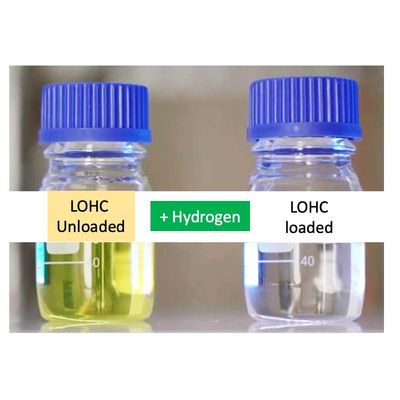
With pressures between 30 – 50 bar and catalysts specially developed for this application, the LOHC can be hydrogenated, i.e. hydrogen can be chemically bound. The resulting hydrogenated LOHC + can then be handled using the known infrastructure for fuels such as gasoline and diesel. The hydrogenation process is exothermic. The waste heat developed in this way can be used in other processes and thus increases the overall system efficiency.

If the hydrogen is needed again, for example in chemical process plants, the steel industry or to supply fuel cells in order to use electrical energy, it can be extracted again from the LOHC +.

In order to dehydrate the LOHC +, i.e. to release the hydrogen from the liquid again, the LOHC + passes through a dehydrogenation reactor, which contains the catalyst required for this process. In contrast to hydrogenation, dehydrogenation is an endothermic reaction. The necessary energy must therefore be added and can, for example, be made available within the system by using the hydrogen itself or provided by other, external heat sources.

The dehydrogenated LOHC- can now be returned to the location of the hydrogenation and reloaded with hydrogen. The cycle is closed. The LOHC itself is not consumed, but reused many times over. The service life is also increased by the possibility of purification as soon as this becomes necessary after various (de) hydrogenation cycles.


 

LOHC is a heat-resistant oil with a capacity of 57 kg hydrogen per 1 m3. Hydrogen is chemically bound to and released from the LOHC in a chemical reaction on a catalyst.

 
  • Safe heat transfer oil, in commercial use for decades
 
  • Globally produced in refineries
 
  • Safe storage/release, transport and handling under ambient ressure/temp. vs. liquid Hydrogen at -252°C (-487 ℉) or toxic Ammonia
 
  • 50x more cost effective than Lithium-Ion batteries
 
  • compatible with existing infrastructure
 
  • infinite storage life
 
  • LOHC cleaning cycles up to 7 years