


- Home
- Companies
- HeatMatrix Group B.V.
- Products
- HeatMatrix - Fired Heaters
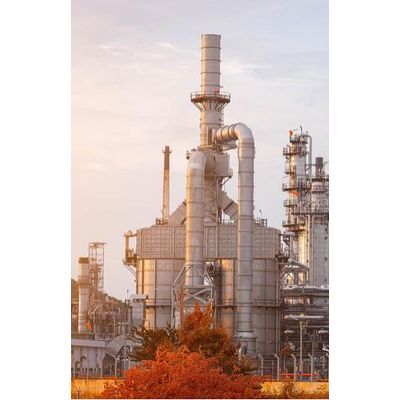
HeatMatrix - Fired Heaters
Cold spot corrosion problems limit heat recovery. A polymer air preheater can recover heat below the acid dew point without corrosion issues.
Fired Heaters are used in oil refining and in the chemical industry. They heat up product streams for the CDU, VDU, platformer, aromatics, hydrotreater and FCC. Most fired heaters have a thermal efficiency of around 85% – 90%. Solomon benchmarks competitiveness of refineries across the globe. Energy efficiency is one of Solomon’s KPI’s which is strongly influenced by the thermal efficiency of the fired heaters.
Chemical companies and oil refineries have to reduce their carbon footprint. Fired Heaters are huge energy users. A further decrease in flue gas temperatures, can contribute significantly to the reduction of energy usage and CO2 emissions. For a 100,000 barrel a day refinery an additional 26,000 tons of CO2 emissions can be avoided per year.
By recovering more heat from flue gas, the usage of combustion fuel can be reduced. This means a reduction in energy costs. A 100,000 barrel a day refinery can reduce an additional 14 MW.
Heat recovery on a Fired Heater can be realised with a waste heat boiler whereby additional steam is produced or with an air preheater where hot combustion air is produced. Heat recovery from flue gas using air preheating typically requires a balanced draft type Fired Heater. Guideline API 560 Annex 3 of the American Petroleum Institute describes proper design for an air preheating section on a Fired Heater. But not all heat can be recovered because of corrosion problems due to acid condensation.
Fired Heaters are typically fired with refinery gas and/or fuel oil. Both fuels contain sulphur. The sulphur will be oxidized when burned to SOx which consists out 2-5% SO3 and the remainder will be SO2. When installing air preheating, it is important to protect the system for cold spot corrosion. The acidic part of the flue gas (SO3) starts to condense at the acid dew point (ADP). This condensation will take place in the coldest part in the process, being the air preheater; this leads to so called cold spot corrosion.
The flue gas temperatures of Fired Heaters after the existing air preheaters typically range from 140 to 250 °C. As a consequence, there is still a lot of additional energy savings possible once the cold spot corrosion problems can be overcome.
Cold spot corrosion problems limit heat recovery on Fired Heaters. The polymer air preheater of HeatMatrix combined with an (existing) metal air preheater enables heat recovery to a flue gas temperature below 100 °C and can boost heater efficiencies to 95% or higher.
-
Increased reliability of existing metal air preheater
The polymer air preheater can be installed in series with the existing metal air preheater. The polymer air preheater protects the metal air preheater for cold spot corrosion and the metal air preheater protects the polymer air preheater for high temperatures. The combination allows heat recovery over a broad temperature range with a reliable operation.
-
Prevention of downstream corrosion
The polymer air preheater can be installed upstream or downstream the ID fan. By-passes in both flue gas and air ducts can be considered for maximum reliability and flexibility. The downstream ducting and ID fan will not be impacted by cooling through the acid dew point because most of the acids are removed.
-
No influence of sulphur fluctuations in fuel
Sulphur fluctuations lead to fluctuations in acid dew point. The operation of the polymer air preheater is insensitive for these variations because it is corrosion resistant.
-
Protection against seasonal temperature changes
The polymer air preheater preheats the air before it enters the metal air preheater. Therefore the metal air preheater always operates at an elevated air temperature and seasonal influences are not posing a cold spot corrosion risk.
-
Elimination existing Steam air preheater
The polymer air preheater replaces an existing steam air preheater. That means that you will not have any steam costs and maintenance costs.