


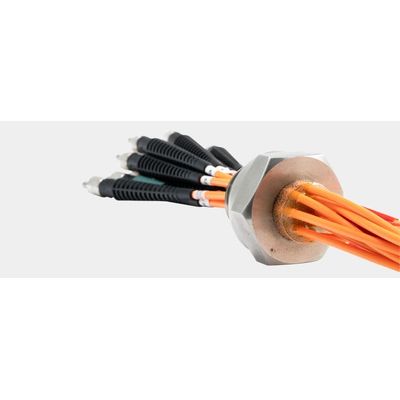
Douglas Electrical Components - Model OptiSeal Series -Hermetic Optical Fiber Feedthroughs
Optical fibers are an efficient way to transmit fast, noise-free signals over long distances. If you’re looking for reliable fiber optic feedthroughs, Douglas Electrical Components has got you covered with our OptiSeal™ products. Our pre-wired and pre-tested interconnecting harnesses and feedthroughs can be configured to accommodate any combination of optical fibers you need. Our team carefully hermetically seals directly to the optical fiber to ensure a true hermetic seal within the bulkhead of the assembly to operate in vacuum and/or positive pressure applications. In-house testing further confirms optical continuity of the optical fibers.
Our certified IPC-620 technicians can handle optical fibers carefully to effectively seal the feedthrough assembly. Designs are available for both vacuum and positive pressure applications. With OptiSeal, you can create a hybrid feedthrough harness that can combines a mixture of copper wires, fiber optic cables, thermocouples, power cables, shielded pairs, triplets, and quads; this can reduce cost and weight, while increasing reliability within your equipment or assembly. Mating harnesses with breakouts can be custom designed with optional features such as FC/APC terminations within individual armored fiber channels.
Douglas Electrical Components can hermetically seal MIL-spec and industrial fiber optic connectors through our backpotting process, making it possible to create a plug-and-play solution in an OEM application requiring optical fibers, from IoT control boxes to military equipment. OFC connector assemblies can also be hermetically sealed for simple integration and ultimate protection of the fiber. Integrate various fiber optic terminated patch cables directly into optical fibers to both protect the fiber and develop a solution that is designed ready for installation.
We also offer design support for explosion-proof assemblies exposed to hazardous liquids and gases with standard taper threads, O-ring seals, and flange designs. OptiSeal can be configured for wire-to-wire, cable-to-wire, as well as connector-to-wire assemblies in UHV and pressurized environments.
Our products also support applications requiring high-speed, complex communication over long distances. Contact the factory for customized bulkhead connector feedthrough designs and capabilities for fiber optic connections.
- <1×10⁻⁹ cc/sec per feedthrough
- Pressures of 15,000 psi
- Operating temperatures range from 4 K (LHe) through high temperatures of 200°C
- Custom bifurcated fiber assemblies with a combination of optical and copper conductors for complex camera systems
- Achieve a custom hermetic fiber optic seal no matter the cable construction, configuration or jacket the assembly requires
- Combine various types of optical fiber into a single hermetic feedthrough
- Qualifications to MIL-spec test method standards such as MIL-STD-810
- Ingress Protection available to IP-69K and NEMA 6P; Hazardous rated designs available
- Standard patch cables
- Singlemode
- Multimode
- Fused glass rod
- Plastic
- Fiber
- Ribbon fiber solutions
- Armored cables
- ISO 9001:2015
- ISO 14001:2015
- ITAR DDTC Registration
- UL 1203 Class I Division 1 Explosion-proof Groups A, B, C, D available
- High Bandwidth
- Immunity to Electromagnetic Interference (EMI)
- Low attenuation
- Light weight
- High temperature tolerance
- Communications, from on-board vehicles and ships to transmitting data across sub-systems
- Research and development equipment, from labs to in-field products
- Sensors, including but not limited to transmitting pressure/force, acoustic, position, velocity/acceleration, and orientation such as IMU’s and gyroscopes,
- Downhole sensors, and other remote monitoring equipment in hazardous areas and harsh environments
- Cameras, imaging, and positioning equipment
- Targeting systems