Influit Energy
  1. Companies
  2. Influit Energy
  3. Products
  4. High Energy-Density Nanoelectrofuel

High Energy-Density Nanoelectrofuel

SHARE
Using perfectly suspended nanoparticles in a water-based fluid, Influit Energy has created high-performance liquid fuel battery systems that will become the new standard for large battery applications with the same performance as Li-ion systems at a lower cost.
Most popular related searches

Our breakthrough is creating a nanoelectrofuel that has low viscosity and won’t settle. Creating a nanofluid out of battery material is relatively straightforward. However, no one else has ever discovered how to make an energy-storing nanofluid that is both low viscosity (it actually flows) and that doesn’t settle (never agglomerating if left alone).

They aren’t as energy dense as solid batteries. Why? Because of specific gravity only so much battery material (ionic salts) can be dissolved in a liquid. Once this natural limit is reached, any additional energy storage salt will sit at the bottom of the battery undissolved and inaccessible to the battery system.

Unlike other flow batteries, Influit does not dissolve anything. Rather we suspend battery nanoparticles in a base fluid. They never settle and are completely unsupported. Influit makes its particles so small that Brownian motion–the random motion of particles suspended in a liquid–is a dominant force counteracting gravity.

Influit surface-modifies its nanoparticles to give them proprietary chemical and physical properties that prevent agglomeration and decrease viscosity. Van der Waal’s forces do not dominate the suspension because of these surface modifications.

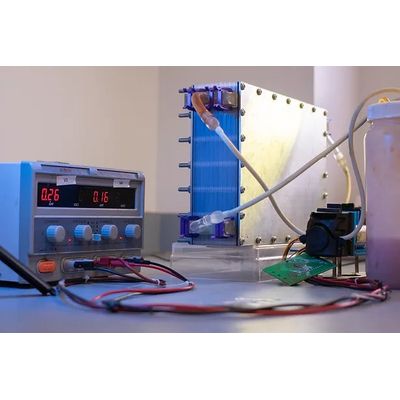
NEF is not a new chemistry, but a new format or new way of storing and distributing electrical energy. We have drop-in replacement battery form factors (imagine a 6T size, but NEF inside) and we have a refueling/recharging unit to create a closed-loop, energy distribution ecosystem (the charged NEF is pumped into a vehicle while discharged NEF is pumped out to be recharged). Our systems are highly flexible and modular, and they are built to suit terrestrial, aerospace, and maritime applications based on these inputs: voltage, current, desired energy storage capacity, and available system space.