


- Home
- Companies
- HM3 Energy, Inc.
- Products
- HM3 - Biocoal Technology - Biocoal from ...
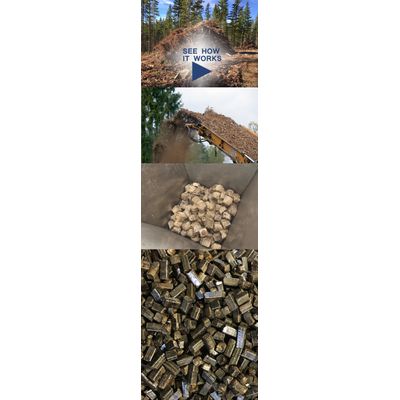
HM3 - Biocoal Technology - Biocoal from Forest Waste
The International Energy Agency names torrefied biomass the cheapest, lowest risk biomass for storage, transport and processing, and also the best form of biomass as a global commodity.
Until now, biocoal has not been able to compete in price with white (raw wood) pellets for the export market. HM3BiocoalTM beats white pellets in $/Gj for export to Europe and Asia. HM3 Energy spent ten years carefully developing its biocoal technology, including a two-year demonstration phase in a 1.5 tons/hour demonstration facility.
- Streamlined Process – HM3BiocoalTM technology is energy-efficient and economical.
- Waste-to-Energy – Forest, sawmill and agricultural residues can all be used to make HM3biocoalTM biocoal. Clean wood chips can also be used.
- Torrefier – A simple mass flow torrefier with one moving part (a leveler) uses little energy to operate and requires less maintenance than other torrefaction equipment. The feedstock evenly torrefies as it makes its way through the reactor via gravity alone.
- VOC Destruction – A reliable and simple combustion system destroys VOCs (volatile organic compounds) while simultaneously drying the feedstock.
- Densification – The 200 hp motor briquetting machine produces sturdy biocoal that can withstand shipping long distances. A die temperature control system keeps dies at a constant temperature to ensure uniform product quality.
- Water Resistance – Post densification conditioning, with no binders added, results in biocoal that remains sturdy after 24-hour submersion in water.
Torrefaction (roasting at a high temperature in an oxygen free environment) is not new. It has been used to roast coffee beans for over a hundred years. It has taken time, however, to apply this technology to evenly roasting wood chips and ground biomass that is not uniform in size. Densification of the torrefied biomass product into pellets or briquettes for economic transport has also taken time to perfect.
- Fibrous Wood Becomes Brittle – Just like roasted coffee beans, wood becomes a dark chocolate brown and brittle. This allows for easy grinding, just like coal, in the coal plant pulverizer prior to being fed to the boiler.
- Water Resistant – Properly densified biocoal is water resistant, just like coal, for easy shipping and storage.
- Reduction in Harmful Emissions – Combustion of torrefied biomass does not produce the harmful emissions such as mercury and sulfur that happens with burning coal.