


- Home
- Companies
- Daye Hongxin Mold Technology Co., Ltd
- Products
- HONGXING - Model Cr12Mo1V1 - High ...
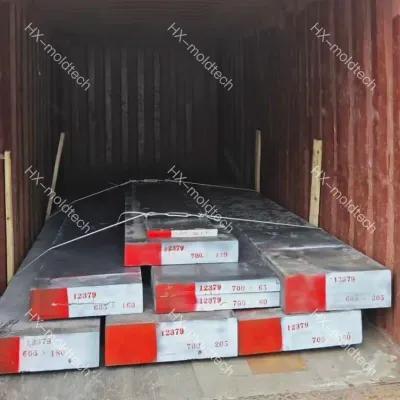
HONGXING - Model Cr12Mo1V1 -High Carbon Chromium Vanadium Tool Steel for Cutting Tools
DIN 1.2379 is a high carbon, high chromium, and high vanadium tool steel, known for its superior hardness, wear resistance, and toughness. It is used extensively in the manufacturing of cutting tools, molds, and dies requiring high levels of abrasion resistance and cutting performance. It is an air-hardening steel that develops hardness upon cooling in still air and exhibits minimal distortion when correctly hardened. The steel offers a hardness range of 55-62 HRC and can be machined in the annealed condition. Its high chromium content provides mild corrosion resistance in the hardened state. These properties make it suitable for long-run tooling applications, including blanking or forming dies, punches, shear blades, and tyre shredders. Proper preheating, hardening, and tempering processes are essential to achieve the desired mechanical properties, including high tensile strength and elongation. The steel is available in various sizes and can be subjected to EAF+LF+VD+Forging+Heat treatment or ESR Melting Process as per the requirement.Cr12Mo1V1 is a versatile tool steel that offers a combination of high hardness, wear resistance, and toughness, making it a popular choice for a wide range of industrial applications.
Cr12Mo1V1 is a high carbon, high chromium, and high vanadium tool steel that is commonly used in the manufacturing of cutting tools, molds, and dies. Its high hardness, wear resistance, and toughness make it suitable for applications that require high levels of abrasion resistance and cutting performance.
- HONGXING
- DAYE
- 30 DAYS
- 10000 TON/MONTH
- DIN 1.2379 is a high carbon, high chromium, and high vanadium tool steel that is commonly used in the manufacturing of cutting tools, molds, and dies. Its high hardness, wear resistance, and toughness make it suitable for applications that require high levels of abrasion resistance and cutting performance. steel introduction
DIN 1.2379 is a high carbon, high chromium, and high vanadium tool steel that is commonly used in the manufacturing of cutting tools, molds, and dies. Its high hardness, wear resistance, and toughness make it suitable for applications that require high levels of abrasion resistance and cutting performance.
DIN 1.2379 steel is an air hardening, high-carbon, high-chromium tool steel. It has high wear and abrasion resistant properties. It is heat treatable and will offer a hardness in the range 55-62 HRC, and is machinable in the annealed condition. DIN 1.2379 steel shows little distortion on correct hardening. DIN 1.2379 steel’s high chromium content gives it mild corrosion resisting properties in the hardened condition.
If customer need better machinability, we recommend A2, because A2 has a chromium content of 5% and is more readily machinable.
- DIN 1.2379 steel application
DIN 1.2379 tool steels are used for long run tooling applications, where wear resistance is important, such as blanking or forming dies, punches, forming rolls, knives, slitters, shear blades, tools, scrap choppers, tyre shredders and so on.
- DIN 1.2379 steel mechanical properties
The mechanical properties mainly include tensile strength, yield strength, elongation, area or reduction, hardness, impact value, non-metalic inclusion etc. Different heat treatment, the mechanical properties will be different, such as normalized, tempered, QT. If you want to know the properties, kindly contact the salesman.
- DIN 1.2379 steel heating treatment
DIN 1.2379 steels alloy should be preheated very slowly to 815℃ (1500°F) and then temperature can be increased to 1010oC (1850°F). They are then held at 1010oC (1850°F) for 20 to 45 minutes and air cooled (air quenched).
- Annealing
Annealing of DIN 1.2379 tool steels material should be done at 871 to 898°C (1600 to 1650°F) followed by slow furnace cooling at 4.4°C (40°F) per hour or less.after which cooling rate may be increased. Suitable precautions must be taken to prevent excessive carburization or decarburization.
- Stress Relieving
When desirable to relieve the strains of machining, heat DIN 1.2379 grade steel slowly to 1050°-1250°F, allow to equalize, and then cool in still air (Strain Relieving).
Preheat Prior To Hardening
Preheat slowly to 1350°-1450°F and hold at this temperature until grade steel DIN 1.2379 material is uniformly heated.
- Hardening
After thorough preheating, heat to 1800°-1850°F. Hold the work piece at the hardening temperature until it is completely and uniformly heated.
- Quenching
DIN 1.2379 steel tool material is an air hardening steel and will develop hardness on cooling in still air. To avoid scaling and prevent decarburization of the work piece surface, controlled atmosphere or vacuum furnaces are recommended. If these furnaces are not available, pack hardening, salt baths or wrapping the piece in stainless steel foil will provide some degree of surface protection in the hardening process. Parts should be allowed to cool to 150F, or to where they can be held in the bare hand, and then temper immediately.
- Tempering
The tempering temperature on material DIN 1.2379 steel may be varied according to the desired hardness. DIN 1.2379 steels can be tempered at 204°C (400°F) for achieving Rockwell C hardness of 61 and at 537°C (1000°F) for a Rockwell C hardness of 54.
- Delivery condition
For hot forged or hot rolled bar, usually the delivery condition is hot forged or rolled, annealed, rough turned.
For hot forged plate, usually the delivery condition is hot forged, annealed, milled surface.
For hot rolled plate, usually the delivery condition is hot rolled, annealed, black surface.
Hongxin Mold Tech Co.,Ltd. owns 1 set of Hot Rolling Production Line at size range flats 8-80*210-710mm, rounds 16-50mm Dia.
12 sets of Hydraulic Forging Hammers from Power 560kgs to 6000kgs which could cover flats 40-300*210-710mm.
8 sets of EF+LF+VD
5 sets of ESR
9 sets of Milling Machines
10 sets of Turning Lathes
6 sets of Precision Milling Machines.