


- Home
- Companies
- GeoPura, Ltd
- Products
- Hydrogen Fuels
Hydrogen Fuels
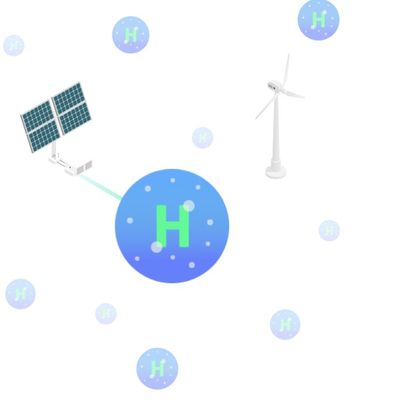
We are at the start of something powerful. To deliver our net-zero commitments, a carbon-free future needs to be fuelled with renewable energy, way beyond the capabilities of any electricity distribution network. By producing green hydrogen we have found a way to store and transport renewable energy as a fuel so that it’s available where and when we need it.
The demand for clean, zero-emission energy is about to increase dramatically as we move away from fossil fuels to heat our homes and businesses and power our transport networks. As World leaders commit to cut emissions viable alternatives have to be found.
Our reliance on fossil fuels is largely due to the ease with which we can release and use the energy stored within it. Renewable energy isn’t quite as convenient, it’s often reliant on specific conditions and its supply can undergo huge fluctuations. If renewable energy is going to meet the requirements of global energy consumption and distribution, a workable energy storage solution is required.
Batteries will be part of the answer, especially for storing and providing short bursts of energy. But when we consider how much our demand for clean energy will increase and the limited capacity of the electricity distribution network we also need to consider off-grid solutions and longer-term options.
Converting renewable energy to green hydrogen that can be stored and transported as a gas or liquid is the answer. GeoPura is providing the means right now for green hydrogen renewable energy generators to exploit this opportunity.
It is estimated that in the EU alone we will invest over €180 billion by 2050 to roll out hydrogen power. We believe that the investment should focus on green hydrogen production through water electrolysis where zero emissions can be guaranteed.
Water Electrolysis
- An electrical current is passed through water using two electrodes
- Hydrogen appears as gas bubbles at the cathode – where the electrons enter the water
- Oxygen appears as gas bubbles at the anode
- The separated hydrogen is pressurised and collected in hydrogen tanks that are then collected, transported, and stored.
When hydrogen is ‘burnt’ in a fuel cell it produces heat and electricity with the only ‘exhaust’ being water (H2O), making it entirely emissions-free.
- A fuel cell consists of two electrodes — one negative and one positive (anode and cathode)
- The electrodes are separated by an electrolyte
- A fuel, such as hydrogen, is fed to the anode, and air is fed to the cathode.
- A catalyst separates hydrogen atoms into protons and electrons which then both travel to the cathode
- The electrons go through an external circuit, creating a flow of electricity.
- The protons migrate through the electrolyte to the cathode, where they reunite with oxygen and the electrons to produce H2O and a little heat