


- Home
- Companies
- Lithium Werks
- Products
- Lithium Werks - Model 18650 - ...
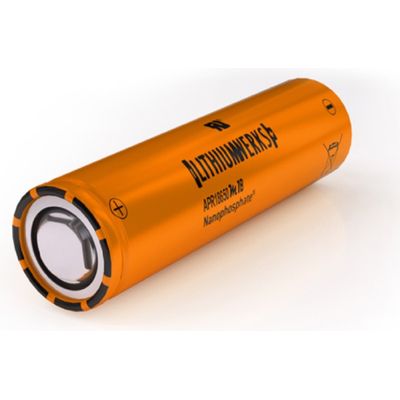
Lithium Werks - Model 18650 -Lithium-Ion Energy Cells
Lithium Werks specializes in high-performance 18650 lithium-ion power cells that leverage patented Nanophosphate battery technology. These cells are renowned for their high power output and are based on the lithium iron phosphate chemistry (LiFePO4), which ensures safety under diverse environmental conditions. Nanophosphate offers advantages such as thermal stability, rapid charging, consistent energy delivery, and minimal capacity degradation over time. This makes them ideal for applications requiring reliable cycle life and float stability. Whether for power, pulse, or standby use, these cells provide a reliable energy storage solution. The cells ensure superior safety with multiple protection layers at the chemical, cell, and system levels.
Lithium Werks’ 18650 cells are capable of delivering very high power due to their use of patented Nanophosphate battery technology. Nanophosphate offers stable chemistry, faster charging, consistent output, excellent cycle life and superior cost performance.
Based on lithium iron phosphate chemistry (LiFePO4), the cells are inherently safe over a wide range of temperatures and conditions. Whether the application requires outstanding cycle life or stable float reliability, the Lithium Werks’ 18650 cells are suitable for a wide variety of power, pulse, or stand-by applications.
Lithium Werks’ 18650 cells are best for Power.Safety.Life. applications. They deliver very high power due to their use of patented Nanophosphate battery technology. Based on lithium iron phosphate chemistry (LiFePO4), the cells are inherently safe over a wide range of temperatures and conditions. Whether the application requires outstanding cycle life or stable float reliability, the Lithium Werks’ 18650 cells are suitable for a wide variety of power, pulse, or stand-by applications.
Nanophosphate battery technology offers thermal-stable chemistry, faster charging, consistent output, low capacity loss over time, and superior total cost of ownership (TCO). It provides the foundation for safe systems while meeting the most demanding customer requirements. Multiple layers of protection are employed at the chemistry, cell and system level to achieve an energy storage solution with superior safety and abuse tolerance compared to metal oxide lithium-ion chemistries.
- Voltage: 3.3 V
- Capacity @ 23°C Typical (Min): 1.2 Ah (1.15 Ah)
- Energy @ 23°C: 3.96 Wh
- Impedance (1kHz AC): <16 mΩ
- Cycle Life at 1C/1C, 100% DOD: > 4000 cycles
- Max. Continuous Discharge Current: 30A (25C rate)
- Max. Pulse Discharge Current (10s): 50A (42C rate)
- Minimum Voltage / HPPC Pulse: 2 V / 1.6 V
- Temperature: -30°C to 60°C
- Recommended Charge Current: 1.5 A (1C rate)
- Max. Continuous Charge Current: 4A (3C rate)
- Max. Pulse Charge Current (10s): 10A (8C rate)
- Recommended Charge Voltage: 3.6 V
- Terminate Charge @ 3.6V: <50 mA
- HPPC Pulse Voltage: 3.8 V
- Float Voltage: 3.5 V
- Temperature Range: 0 ºC to 60 ºC
- Storage Temperature: -40 ºC to 70 ºC
- Diameter: Ø18.5 +/- 0.1mm
- Length: 64.95 +/- 0.2mm
- Mass: 41.5 +/- 1.0g