


- Home
- Companies
- Lithium Werks
- Products
- Lithium Werks - Model 32140 - ...
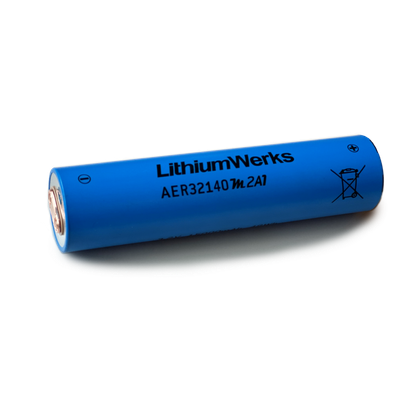
Lithium Werks - Model 32140 -Lithium-Ion Energy Cells
Lithium Werks` 32140 energy cells leverage the advanced lithium iron phosphate (LiFePO4) battery technology to deliver high-energy and high-power performance. These cells are built to provide a stable thermal chemistry, ensuring faster recharge times and consistent power output without significant capacity loss over time. Recognized for their superior total cost of ownership, the cells are particularly advantageous in application settings that require long cycle lives or stable float reliability. These 32140 energy cells are versatile, making them suitable for a range of applications in the e-mobility, energy storage, and industrial sectors. Unlike traditional metal oxide lithium-ion chemistries, these energy cells offer enhanced safety features, including multiple protective layers at the chemistry, cell, and system levels, which reduce the likelihood of misuse and increase resilience under variable temperature and condition ranges.
Lithium Werks’ 32140 energy cells are capable of delivering high power and high energy due to their use of lithium iron phosphate battery technology.
Based on lithium iron phosphate chemistry (LiFePO4), the cells are inherently safe over a wide range of temperatures and conditions. Whether the application requires outstanding cycle life or stable float reliability, the Lithium Werks’ 32140 cells are suitable for a wide variety of e-mobility, energy storage, and industrial applications.
Our lithium iron phosphate chemistry (LiFePO4) provides the foundation for safe systems while meeting the most demanding customer requirements. Multiple layers of protection are employed at the chemistry, cell and system level to achieve an energy storage solution with superior safety and abuse tolerance compared to metal oxide lithium-ion chemistries.
- Energy LFP cells can be fully charged to 100% without causing accelerated battery degradation.
- The phosphorus-oxygen bond in LFP cathode greatly reduces the release of oxygen, which reduces the opportunity to propagate into a thermal runaway, making LFP much safer than metal oxide cells.
- LFP cathode is made from earth abundant materials making this technology more ecofriendly and price stable.
- LFP Energy cylindrical cells have higher gravimetric and volumetric energy densities, are chosen for longer duration applications, and have excellent safety characteristics i.e. long life, high cycle life, and improved total cost of ownership.
- LFP Power cells are designed for high charge/discharge C-rates, shorter duration applications, and maintain extreme safety characteristics, long calendar life & high cycle life applications, and are the best total cost of ownership.
- Voltage: 3.2 V
- Capacity @ C/5 Typical: 15 Ah
- Energy: 48 Wh
- Specific Energy: >172 Wh/kg
- Energy Density: 396 Wh/L
- Impedance (1kHz ACIR) Typ: < 3 mΩ
- Cycle Life at 0.5C/0.5C, 80% DOD: > 3500 cycles
- Cycle Life at 0.5C/0.5C, 80% DOD 45ºC: > 2000 cycles
- Recommended Cont. Discharge Current: ≤ 15 A (1C)
- Max Continuous Discharge Current: 45 A (3C)
- Max Pulse Discharge Current, 30s: 75 A (5C)
- Minimum Voltage: 2.0 V
- Temperature: -10 ºC to 60 ºC
- Recommended Charge Voltage: 3.65 V
- Recommended Charge Current: ≤ 7.5 A (C/2)
- Fast charge (20-80% SOC): 15 A (1C)
- Charging Profile: CC/CV
- Float Voltage: 3.45 V
- Temperature: 0 ºC to 60 ºC
- Storage Temperature: -20 ºC to 70 ºC
- Diameter: Ø33.4 +/- 0.2 mm
- Length: 140.0 +/- 0.2 mm
- Mass: 275 g +/- 5.0 g