


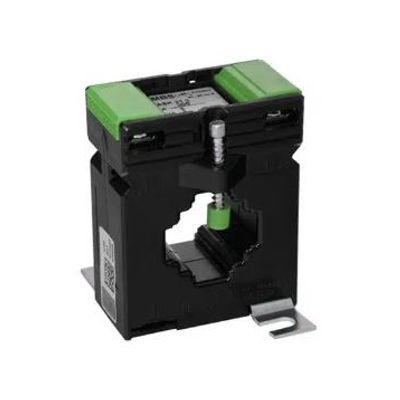
MBS - Model KS -Low Power Current Transformer
Unlike conventional current transformers with a 1 or 5 A secondary output signal, current sensors output a voltage signal.
As can be seen in the illustration, a conventional current transformer is loaded with a measuring resistor in the housing. In most cases, the resistor value is between 0.5 and 5 ohms and converts the current signal into a voltage signal. According to international standardisation, 22.5 mV, 150 mV and 225 mV are specified for the output voltage. In addition to these values, the value 333 mV has also become established on the market.
Currently, small-signal measuring transformers are not approved for offsetting measurements, so they are usually connected to universal measuring devices with voltage input channels. The impedance of these input channels can be described as high-impedance and is usually well above 10 kOhm, so that only a very small proportion of the secondary current actually flows through the resistance of the measuring device. The measuring accuracy of the current sensor is therefore not significantly influenced by the measuring device and the supply line. An exact burden determination as with conventional current transformers can be omitted. Over- or under-burdening is ruled out. At the same time, dangerous open-circuit voltages are no longer possible due to the low-resistance loading in the transformer housing at the secondary terminals.
The primary and secondary connections are also labelled as for current transformers.
As with current transformers, these are passive transformers that do not require an additional power supply. The general normative requirements for these devices are currently defined in the following international standard:
IEC 61869-10: Instrument transformers – Additional requirements for passive small-signal current transformers
The accuracy classes are defined similarly to the known current transformer classes.