


Iontof Gmbh
- Home
- Companies
- Iontof Gmbh
- Products
- Model Qtac - High Performance Low ...
Model Qtac -High Performance Low Energy Ion Scattering (LEIS)
FromIontof Gmbh
The Qtac is a high sensitivity Low Energy Ion Scattering (LEIS) instrument. It is extremely surface sensitive, providing quantitative elemental characterisation of the top atomic layer. This instrument has been developed to include small spot analysis, surface imaging, and both static and dynamic depth profiling. Its unique surface sensitivity makes the Qtac the perfect tool to study surface processes. The Qtac provides valuable information in many production and research areas on materials such as catalysts, semiconductors, metals, polymers, and fuel cells.
Most popular related searches
- Quantitative, elemental characterisation of the top atomic layer
- Spectroscopy, imaging and depth profiling capabilities
- Time-of-flight mass filtering for improved sensitivity
- Analysis of rough and non-conductive materials
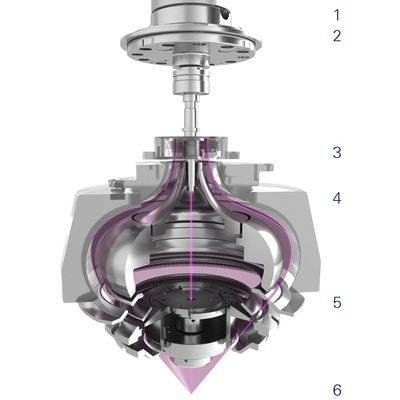
The unique Qtac energy analyser design is based on the advanced Calipso technology. At the optimum scattering angle, the analyser has an acceptance over the full azimuth while maintaining a well-defined scattering angle.
This, together with parallel energy detection, simultaneously provides high sensitivity and high mass resolution. The possibility of using heavier noble gas ions, which is usually not possible with conventional ion scattering spectrometers, is essential for unambiguous identification of all elements.
The dedicated analyser design allows for non-destructive, reproducible and quantitative analysis of the top atomic layer.
- Noble Gas Ion Gun
- Pulsing System
- Position Sensitive Detector
- Energy Analyser
- Focussing Optics
- Sample
In conventional LEIS, secondary ions, generated by the impact of the noble gas ions, lead to a high background for low scattering energies.
This background reduces dynamic range and detection limits, in particular for light elements.
The Qtac is equipped with a time-of-flight detection system, which separates the scattered noble gas ions from this background. This unique feature significantly improves the elemental detection limits and the dynamic range of the instrument.