


- Home
- Companies
- Whirlwind Energy
- Products
- Whirlwind Energy - Modern Wind Turbines
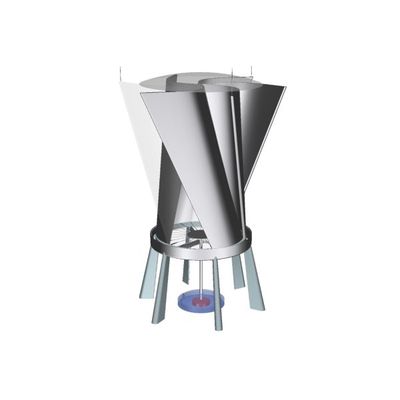
Whirlwind Energy - Modern Wind Turbines
The main problems of modern wind turbines (those with horizontal axis types) that inhibit the development of wind power engineering and which are solved by a new type of wind power plant:
Source: https://whirlwind.energy/
Inefficiency of modern wind power plants in gusty wind and / or with a rapid change in wind direction.
Narrow operating range of wind speeds, high start-up speed and rated wind speed.
Complexity of maintenance (repair and replacement of worn parts of the wind power plant) due to the location of the main power components, yaw system, control systems etc. on a mast.
Design constraints of the installed capacity due to the location of the majority mass of the equipment (generator, multiplicator, yaw system, electrical equipment and turbine) on a mast.
Low profitability in the absence of government benefits and subsidies due to low Efficiency rated output (Capacity factor) and short lifetime (15-25 years) that also creates the problem of recycling.
Large exclusion zone around wind farms not only because of the noise but also because of scattering of the turbine fragments in case of destruction or of ice while icing over considerable distances.
High efficiency of the proposed wind power plant is provided by the airflow vortex concentrator (which does not require any yaw system) as well as by the turbine blades’ control system that is located in a hub in the center of the working zone (the disk in the base of the vortex concentrator) from where rods with blades at their ends move out radially. The vortex concentrator provides a spiral movement of the captured airflow to the turbine blades through the outer edge of the working zone. The width of the airflow is mere 20-25% of the working zone’s radius that is there is no any air movement in the center of the vortex concentrator like in the center of a hurricane. Therefore it is sufficient for the blades to have a length of no more than 20-25% of the radius of the working zone in order to use the energy of the air flows in full. Thus, the blade control system can completely or partially remove the blades from the influence of air flows.
The concentration of the airflow and the moment of force applied to the blades of the turbine provide a low start-up speed of the unit (up to 1 m/s).
The control system provides the turning of the blades to change pitch angle as well as the retracting of the rods for transformation the low-speed multi blade turbine in three-bladed turbine with high rotation speed or completely retracts all the rods to prevent breakage in a storm wind. All this extends the operating range of wind speed, and also reduces the wind load when wind speed increases up to 15-20 m/s or higher.
Due to the mass of the hub with the control system it is a flywheel with auto balancing system, smoothing the gusty wind and preventing low-frequency vibrations. This system ensures the smooth operation of the generator and reduces the wear of mechanical systems. The expected Efficiency rated output (Capacity factor) is 60-80% vs. 30-40% in the modern wind turbines, depending on wind power potential of the region.
Generator, CVT, electrical equipment and controller with operator’s control panel are at the bottom of the wind power plant, in a domed building, providing the easy access to the systems of the power plant and the absence of restrictions on the mass/capacity of the equipment.
The bearing structures of prestressed concrete provide the lifetime of the new wind power plant from 50 to 100 years and more.
The turbine’s location in the working zone of the vortex concentrator, surrounded on all sides by bearing elements of the structure, eliminates uncontrolled scattering of fragments of the blades in case of destruction, and of ice while icing. In addition, the external elements that surround the working zone shield from the noise produced by the turbine.
This design allows to scale the wind power plant. The Bearing structures can be initially built with the expectation of a larger height and power, with a larger diameter of the working zone. At the same time, a concentrator with a working zone made as an insert and a generator are initially installed designed for the less power, thereby reducing the initial investment of the wind farm. The design of the turbine with retractable rods with blades allows to adapt it to different diameters of the working zone. To increase the power of the wind power plant, it is enough to change only the concentrator with the working zone to larger ones and buy an additional generator, which is installed together with the first one.