


- Home
- Companies
- NS Instruments
- Products
- NS-Instruments - Model MultiTalent 109 ...
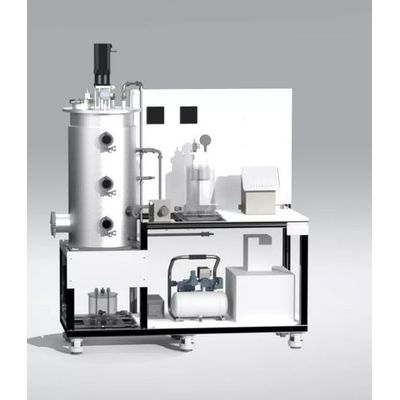
NS-Instruments - Model MultiTalent 109 -Material Methane Production Potential System
The material methane production potential (BMP) test is a type of assessment of the amount of methane produced by a fermented substrate. It can provide an important basis for the design of key parameters such as organic load and residence time in biogas engineering and the fermentation optimization strategy; through the methane production potential test of different mixed proportions of organic waste, important parameters of the joint digestion process of organic waste can be obtained.
The test consists of a batch-fermented small reactor, which measures the production of trace gases under anaerobic conditions with temperature and mass transfer settings, and converts it into ml-gas/g-vs substrate units under standard STP conditions. The methane degradation kinetic data obtained through the test can also obtain information on fermentation inhibition such as hydrolysis speed limit. It is of great significance to understand the efficiency of biogas fermentation and its process stability, guide the digestion process, production optimization strategy and biogas engineering investment income assessment.
- Larger reactor volume: The larger the fermentation capacity, the smaller the error impact of other factors
- Standardized fully automated testing: saving time and labor savings
- Standardized test process and data output, local access and operation of touchscreen
- Low water bath evaporation loss: even high temperature fermentation conditions can minimize evaporation loss
- Flexibility to add custom ports. Large diameter lids allow for the assembly of additional ports
User feedback
Biogas Research and Development for People and Bio, Reduces Different Changes Using MultiTalent 109 Fully Automatic Methane Potential Test SystemThe researchers obtained reliable process operation data based on differences in test results due to differences in experimental skills during the test process. At the same time, the collection of large amounts of data enriches the understanding of the whole plant operation. According to the needs of the second phase of the project construction, using the surrounding organic waste available, the material methane production potential tester AMPTA-MultiTalent is used to carry out the co-digestion experiment of the lab-scale, which is convenient for the company`s technical management to come up with the recommendation of the operation optimization of the biogas project.
Relying on rich industrial resources, people and organisms have built high-tech projects such as biogas power generation projects, biogas purification biogas projects, functional water-soluble fertilizer
The MultiTalent 109 is based on the 203 flagship software control logic and design concept, specifically for the rapid evaluation of material biogas or methane potential of the new product, which increases the volume of the fermented bottle to 1 L on the basis of the original (optional 2L for continuous inlet and outing) and reduces the number of fermentation bottles and product channels to 9. Suitable for biogas plant testing all phase substrate fermentation potential to determine the amount of engineering input experiments, to meet the needs of project design units and factory laboratories for material screening and evaluation of research experiments, to help researchers optimize engineering design and process operation parameters.
Standardize the testing process for practical teaching
Anaerobic digestion technology, as a mainstream treatment technology for solid waste and high concentration organic wastewater, plays a key role in pollution reduction, energy recovery and other fields. In view of the outstanding problems in the process of new engineering professional construction, in the practical teaching equipment configuration process, with the help of MultiTalent 109, continuous feeding operation simulation Sekvent and other instruments, arrange material methane production and toxicity testing, in order to optimize the process parameter design, so that practical teaching as much as possible combined with real teaching products, so that students understand the comprehensive, advanced and cutting-edge environmental engineering technology.
Unattended test function to help project process improvement
Unattended, fully automated operation is critical to the user, so we simplify the operation and maintenance process. After loading the sample, from the start of the experiment, MultiTalent can perform more than 1500 hours of unattended accurate analysis. Through the embedded processor on the device real-time monitoring and touch screen real-time display and interoperable operation, you can observe the progress of the experiment, prepare the sample analysis or other operations after the experiment in advance.
The ultimate accurate measurement
Improved test accuracy and stability with ARM embedded processors. Extensive test coverage for anaerobic fermentation resolution. Advanced 9-channel parallel testing with optimal experimental flux. The gas production data is monitored in real time during the reaction process, and the existing data can be pre-analyzed before the experiment is completed. With the top-of-the-emption calibration function, the data can be corrected based on the topspace size and CO2 concentration estimates to provide more accurate and reliable methane production data.
MultiTalent 109 is a common platform for anaerobic biodegradability, methane potential (BMP) and methane production activity (SMA) test protocols, which meet the experimental step requirements of relevant international biodegradability testing standards and perfectly articulates degradation dynamics information. The high-quality data results make it possible to compare data from laboratories of different research institutions around the world.
Anaerobic reaction unit
- Maximum number of reactors per batch: 9 Reactor material: glass
- Reactor volume: 1L
- Water bath size: 53 × 33.5 × 24.2 cm (18 L)
- Temperature control: 30-95 °C (accuracy ±0.2 °C)
- Material mixing: mechanical mixing, controlled mixing rate and cycle, maximum speed of 200 rpm
CO2 adsorption unit
- Number of CO2 adsorb bottles: 9 reactors can be connected at the same time
- CO2 adsorption bottle volume: 250mL
- Dimensions: 38 × 35 × 11 cm
- Absorbent: 80ml, 3M NaOH solution and pH indicator (not available)
- CO2 absorption efficiency: >98%
- Gas flow and DAQ unit
- Principle: Gas-liquid Replacement and Ballpower Control
- 9 sets of trace gas flow can be operated at the same time
- Built-in temperature and pressure sensor
- Inline chip completes automatic data acquisition and analysis
- Measurement resolution: 1.8 mL (standard)
- Detection capacity: Single set of standard configuration channels (1.8 mL resolution) cumulative gas production measurement up to 35L
- Dimensions: 60 × 16 × 34 cm
- Materials: Engineering plastics, aluminum alloys
- Accuracy of repeatability: ±1%
Software and systems
- Professional software for biodegradability, methane production potential and anaerobic toxicity testing
- Running Linux-based applications via built-in servers
- Online monitoring of gas flow and cumulative volume
- Real-time on-line pressure and temperature standardization correction
- Automatically corrects overestials caused by nitrogen filling in pre-fermentation
- Multiplexing technology supports independent running batch experiments at different start times
- Provide user-friendly interface guidance for experimental design
- Provides real-time system diagnostic logs
- Power supply: 24 V DC/3A (anaerobic reaction unit: mechanical mixing) 12 V DC / 3A (gas flow and DAQ unit)
- Environment: Indoor