


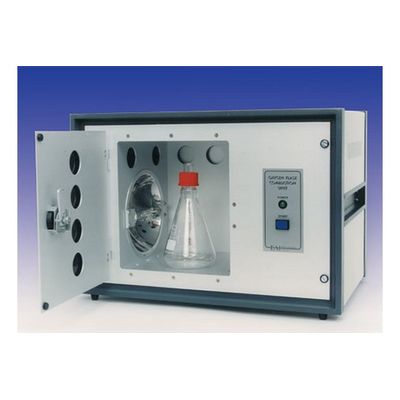
EDI - Oxygen Flask Combustion Unit
The Schöniger flask method is a well proven technique for the combustion and then subsequent analysis of a range of elements including Chlorine, Bromine, Iodine, Fluorine and a number of metals. The combustion of the sample is a simple procedure and involves placing a few milliliters of absorbent solution in a flask. The sample is weighed out and placed in an ashless filter paper holder which in turn is placed in a platinum basket attached to the stopper of the flask. The flask is filled with oxygen and the stopper is then placed in the flask. The sample is combusted and the resultant combustion products are absorbed into the solution.
The Oxygen Flask Combustion Unit is a safe and repeatable method of igniting the samples when using the Schöniger procedure. Reflectors focus the infra-red heat from two tungsten-halogen lamps onto an area approximately 10 cm above the center of the chamber. The lamps only operate when the chamber door is fully locked. The “START” switch fires the lamps for 10 seconds. In the event of a flask explosion, pressure is vented safely through holes in the chamber and any glass fragments are contained within the chamber. The unit has an aluminum interior for rigidity and corrosion resistance, and a thick black acrylic observation window.
The analysis of :-
- Chlorine, Bromine, Iodine, Fluorine
- Sulfur
- Phosphorus
- Boron
- Some trace metals in organic matrices.
- Safety, any potential explosion is contained within the unit itself
- The combustion procedure is carried out in a sealed flask minimising any potential combustion product leaks. Interlocks prevent operation if door is open
- Low cost of initial unit and next to zero running costs
- Simple operation
The Infra red heat energy from two tungsten halogen lamps is focused via parabolic reflectors onto an area approximately 10cms above the centre of the ignition chamber.
The fuse of the ashless filter paper containing the sample is placed within this focused area and ignites the sample. The sample has previously been placed within the ashless filter paper flag inside a platinum basket. The basket is hung inside a schoniger flask within which there is an oxygen rich environment. The sample is fully combusted within a few seconds once the pre-timed ignition sequence is activated. The flask contains an absorbent liquid which absorbs the combustion products prior to final determination via titration, ion chromatography etc.