


- Home
- Companies
- Shangyu (Shenzhen) Technology Co., Ltd.
- Products
- CPSY - Polycrystalline Solar Panel
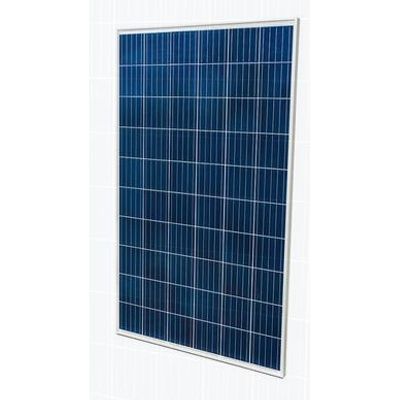
CPSY - Polycrystalline Solar Panel
The manufacturing process of polycrystalline solar panel is similar to that of monocrystalline silicon solar panels, but the photoelectric conversion efficiency of polycrystalline solar panels is much lower, and its photoelectric conversion efficiency is about 12%. In terms of production cost, it is lower than monocrystalline silicon solar panels. The material is easy to manufacture, saves power consumption, and the overall production cost is low, so it has been widely developed.
Polycrystalline solar panels are assembled from polycrystalline silicon solar cells on a board in a specific connection method. When solar panels are illuminated by sunlight, the light radiation energy is directly or indirectly converted into electrical energy through the photoelectric effect or photochemical effect. Compared with traditional power generation, solar power generation is more energy-saving and environmentally friendly, with simple manufacturing process and lower cost. Its production process is divided into silicon wafer inspection - surface texturing - diffusion knotting - dephosphorization of silicate glass - plasma etching - anti-reflective coating - --Screen printing----Fast sintering, etc. Polycrystalline solar panel, polycrystalline solar panel, ultra-white cloth pattern tempered glass. The thickness is 3.2mm and the light transmittance is over 91%.
- Made of ultra-white textured tempered glass with a thickness of 3.2mm, within the wavelength range of the solar cell spectral response (320-1100nm), it is resistant to aging, corrosion, and ultraviolet radiation, and the light transmittance does not decrease.
- Components made of tempered glass can withstand the impact of an ice ball with a diameter of 25 mm at a speed of 23 meters/second, and are strong and durable.
- Use a high-quality EVA film layer with a thickness of 0. 5mm as the sealant of the solar cell and the connecting agent with glass and TPT. It has a high light transmittance of more than 91% and anti-aging ability.
- The aluminum alloy frame used has high strength and strong resistance to mechanical impact.
- Encapsulated using tempered glass and waterproof resin, the service life can reach 15-25 years, and the efficiency will be 80% after 25 years.
- Photoelectric conversion efficiency is about 12-15%
- The amount of waste silicon is small, the manufacturing process is simple and the cost is lower
Performance requirements after curing of EVA film for solar cell packaging: light transmittance greater than 90%; cross-linking degree greater than 65-85%; peel strength (N/cm), glass/film greater than 30; TPT/film greater than 15; Temperature resistance: high temperature 85?, low temperature -40?.
Solar panels raw materials: glass, EVA, battery sheets, aluminum alloy shells, tin-coated copper sheets, stainless steel brackets, batteries and other new coatings have been successfully developed.
- Off-grid power supply for cabins, vacation homes, travel RVs, campers, remote monitoring systems
- Solar energy applications such as solar water pumps, solar refrigerators, freezers, televisions
- Remote areas with insufficient power supply
- Centralized power generation in power stations
- Solar buildings, home roof grid-connected power generation systems, photovoltaic water pumps
- Photovoltaic systems and power systems, base stations and toll stations in the field of transportation/communication/communications
- Observation equipment in the fields of petroleum, ocean and meteorology, etc.
- Home lighting power supply, photovoltaic power station
- Other fields include supporting automobiles, power generation systems, power supply for desalination equipment, satellites, spacecraft, space solar power stations, etc.