


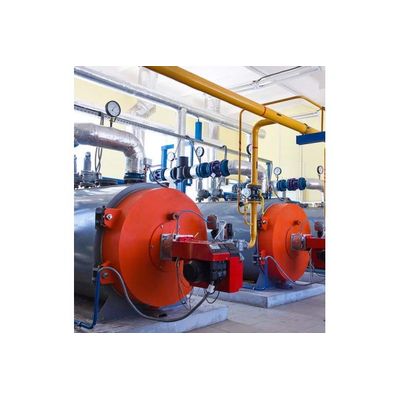
Purite - Industrial Boilers
Boilers, providing heat and steam, are used throughout industry. Where large volumes of live steam are essential, such as in breweries, food and beverage production and chemical plants, the cost of operating boiler systems can often be high – and with the rising cost of gas and oil, these costs are only set to rise still further. Most industrial boilers use a simple demineralisation or softening system to treat supply water. In certain applications, for example, where there is minimal requirement for live steam and condensate return, where the source water is relatively soft or levels of total dissolved solids (TDS) are low, then a demineralisation plant can provide an acceptable solution.
For many applications, however, the reverse is true, especially for boilers with steaming rates over 8 tonnes/hour. The problems can vary, but typically include frequent blowdowns, with associated downtime and high fuel bills, an increased risk of boiler scaling and fouling, with greater use of chemicals, and the subsequent impact on your carbon footprint. Depending on how the wastewater from the blowdown process is handled, there may also be additional cost of discharging to drain, or of placing additional burden on downstream waste handling systems.
What you need to know:
- Boiler output: typically, this needs to be in excess of 8 tonnes/hour for an RO system to provide an effective solution (note that in some circumstances smaller boilers can also benefit from a RO system, so it’s always worth talking to our specialists about your specific requirements).
- Live steam: if a large volume of live steam is being used, with a low level of condensate return, then considerable quantities of make-up water will be required.
- Water hardness: if your source water is drawn from a hard water region, generally above 200 – 1500µS/cm, then it will contain high concentrations of dissolved salts, which will cause faster scaling of boiler tubes and pipework.
- TDS levels: BS2486, the standard for boiler operation and safety, stipulates that the maximum TDS level for fire tube boilers is 5,000 mg/l and 3,500 mg/l for water tube boilers. Once these levels are reached a blowdown must be carried out to prevent foaming, wet steam and carry-over, and to eliminate the risk of damage to the boiler and the safety of operational staff. Clearly, the higher the level of TDS in the feed-water, the greater the frequency of blowdowns; TDS has to be measured in both the feed and make-up water.