


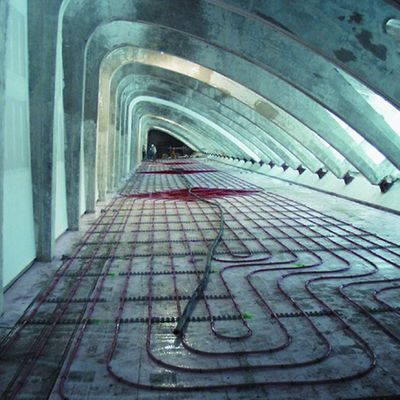
REHAU - Radiant Heating System
If a thermostat reads 70°F (21°C), will everyone in the room be comfortable? Probably not. The temperature of the surfaces around you, air speed coming out of your vents, humidity and air temperature are factors that your heating or cooling systems can address. Your clothing and metabolic rate also contribute to your comfort. Together, these are the six primary factors that influence human comfort. With radiant, you can control more human comfort variables. Specifically, you can adjust the actual surface temperatures of the objects in a space by emitting heat through a network of PEX pipes hidden in the floors, ceilings or walls. By changing the temperature of the surfaces around you, less of your comfort depends on the temperature and velocity of the air in a room.
What do people love about radiant heating?
- Radiant, sometimes called under-floor, heating is a way to heat a building by circulating warm water through a network of RAUPEX® piping, typically embedded in concrete.
- The warm surfaces radiate to the objects and people in the space, creating a comfortable environment.
- You don't need to step out of the shower on to a freezing tile or sit in a different part of the office to avoid a forced-air draft anymore!
Save ~30% on your heating bills with well-designed radiant systems.
Room-by-room control
Do you like your bedroom a different temperature than your bathroom? With radiant, you can create many zones in your building. That means you could maintain a warm floor in a bathroom, while keeping the adjacent bedroom cooler.
Flexibility in architectural design
Architects love radiant, because you can reduce the HVAC clutter in a space. Architect Frank Lloyd Wright even used radiant in his iconic Fallingwater House. Radiant heating is often used for floors, but can also be installed in walls and ceilings.
Energy efficiency
Low supply water operating temperatures and large surface areas are key for reducing fuel consumption. In best cases, the water for a radiant system is warmed by energy-efficient, condensing boilers or renewable energy sources.
Heat emission from the human body occurs mainly via four mechanisms: radiation, evaporation, conduction and convection. Humans feel most comfortable when they can regulate at least 50% of their heat emission via radiation.
As an example, you feel warm when you stand in direct sunlight, even on a cold day. While the air temperature may be cold, the warm radiation from the sun feels nice. With radiant heating, the entire floor of your home can be a warm heat source, radiating heat to warm your skin. As an added bonus, all of the objects on the floor warm up, so no more ice cold chairs.
Human comfort is a complex topic. Experts at ASHRAE have developed a building standard focused on human occupancy. Robert Bean, host of healthyheating.com also has great explanations for how all of the complexities of comfort work together.
Whether you are a residential contractor needing to distribute hot water to radiant manifolds or baseboards, or a commercial contractor needing to distribute hot water to a snow melt system or cooled water to a chilled beam system, anywhere you're using hydronics, PEX pipe can be the distribution method.
REHAU account manager Donna VanMeter explains why PEX is a highly workable, robust and quick-to-install piping system in an article for PHCP Pros.