


Horad
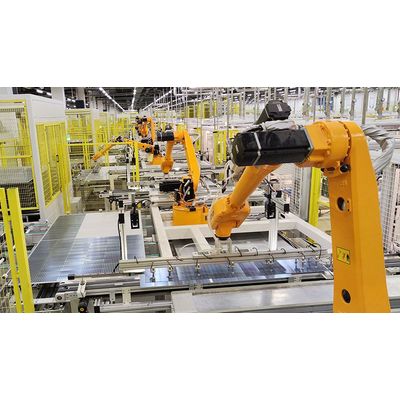
Horad - Robot String Layup Machine
FromHorad
The Robot String Layup Machine is an advanced robotic solution designed to automate the process of placing cell strings onto glass substrates for solar panels. Leveraging cutting-edge machine vision technology and intelligent algorithms, this machine can quickly and accurately identify the size and configuration of solar panels, facilitating the creation of precise layup programs tailored to various cell strings. This boosts production automation and ensures high efficiency. Additionally, the machine supports an automatic edge taping system for dual-glass solar modules, capable of adapting to different tape specifications. It also includes a versatile trimming machine that can handle panels of varying sizes and shapes with high precision, speed, and quality, while maintaining low noise levels. The automatic glass loading machine ensures a reliable, continuous supply of glass by utilizing advanced technologies for loading, positioning, and transporting glass. Committed to providing comprehensive solar panel manufacturing solutions, Horad offers customizable turnkey lines to meet the specific needs of its customers.Most popular related searches
A robot string layup adopts leading machine vision technology and intelligent algorithms to rapidly and accurately identify the solar panel’s size and other information. The layup robot can efficiently produce accurate layup program according to different cell strings, boosting the production automation.
Item: Parameters
Cell size: 156mm*156mm-210mm*210mm
Panel size: (1,680-2,650)*(992-1,500)mm
Cycle time: ≤6s/string
String positioning accuracy: ±0.2mm
Glass size: (1,680-2,650)*(992-1,500)mm
Overall dimensions (L*W*H): 4,220*2,920*2,900mm
Voltage: 3 phase 5 wire 380V, 50Hz, AC±20%
Power: 3kW
Air pressure: 180L/min
- The contactless CCD positioning system is adopted for positioning accuracy;
- Automatic barcode placement for production efficiency and accuracy;
- The string delivery belt is driven by the servo motor to improve the transport stability;
- Full and half cell connection patterns can be switched with a button;
- Able to be connected with the mainstream stringer to produce A/B strings;
- Aligning with the stringer’s single-track 12-string production mode;
- Having the manual feed port for string repair;
- Adapting to horizontal and vertical-type panels