


CT Systems
- Home
- Companies
- CT Systems
- Products
- ROTON - magnetic impulse cavitation ...
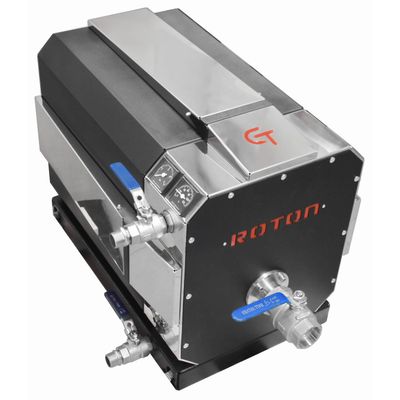
ROTON - magnetic impulse cavitation processors
FromCT Systems
ROTON-B magnetic impulse cavitation processors
The reactor ROTON-B is the core element of the automatic equipment BIOTRON-R. It is the result of the latest developments of our company in the field of physico-chemical mechanics and sonochemistry.
Cavitation in the processors ROTON-B is created by the magnetic impulse hydrodynamic method. Currently, it is the most effective method to create cavitation directly in the fluid stream, patented by our company. The cavitation cloud is held by a magnetic field exactly in the processing area of the reactor and has an immediate effect on the feedstock passing through the cavitator. Therefore the high efficiency, reliability and durability of our units is ensured. The processors ROTON-B do not require high quality feedstock and currently have the highest efficiency among biodiesel production equipment. Most popular related searches
electric power
electrical power
biodiesel product
biodiesel production
biodiesel production system
biodiesel fuel
energy consumption
biodiesel plant
biodiesel
biodiesel equipment
- “One pass” reaction procedure Unlike in outdated “tank” technologies, no re-etherification reaction is needed in magnetic impulse cavitation technology. This innovation means that the time taken to obtain biodiesel is reduced by a factor of 8-10.
- Purifying sorbates, washing and drying are not required When using conventional technologies, it is not possible to obtain proper quality biodiesel fuel immediately. Therefore a process of impurity elimination, involving washing or purifying using sorbates, is needed. This requires additional equipment for primary biodiesel product washing (a mixture of water and alcohol is usually used for this purpose) and additional units for what is known as vacuum drying. When the cavitation biodiesel manufacture method is used there is no need for the finished product to be washed or dried, and this therefore eliminates waste water and sorbate utilization processes.
- Minimal alcohol and catalyst quantity. No alcohol recovery process One of the main problems with “tank” technologies is the need to add, and consequently to recover, additional methanol to the reactor. This requires additional equipment and wastes electric power. In cavitation technology, the alcohol quantity used for the reaction conforms precisely to the stochiometric composition, i.e. the minimum volume. There is no need for a re-etherification reaction. The use of expensive and dangerous equipment for methanol recuperation is excluded from the process. Any inevitable alcohol losses during recovery are eliminated, which improves the environmental conditions and explosion-proof characteristics.
- Minimum energy consumption Conventional biodiesel production methods are based on heating the oil to 67-70 °C. This involves significant electric power costs; in addition, the methanol recovery process (required when the reaction is carried out using conventional technologies), additional re-etherification and also vacuum dehydrating lead to considerable electric power consumption. The use of cavitation processing eliminates all the stages mentioned above, which means that 5-7 times less electric power is used.
- Low-temperature reaction In high-frequency magnetic impulse cavitation, processing takes place in the reactor on molecular level. All components are exposed to magnetic-directed cavitation pulses. Fatty acid molecules are split using micro-explosions; this results in a decrease of viscosity, a cetane number increase, an improvement in the energetic parameters of the future fuel and a considerable acceleration and improvement of the etherification reaction quality. It must be noted that the reaction takes place at room temperature and there is no need to heat the oil.
- Minimal overall module dimensionsOur automatic modules take up 5-10 times less floor space than conventional equipment of a similar capacity.
- Capacity (rated), liters per hour: 500
- Rated power, kW: 7.5, 15, 30
- Operation mode: continuous
- Flow rate adjustment: yes