


NovaCentrix
- Home
- Companies
- NovaCentrix
- Products
- PulseForge - Model 3300 - Semiconductor ...
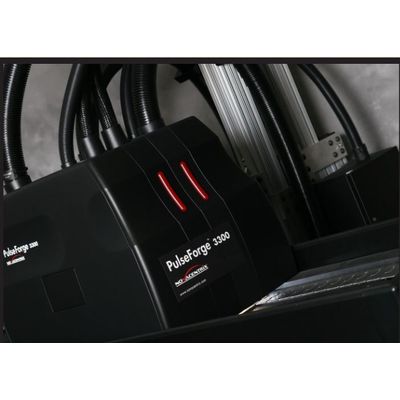
PulseForge - Model 3300 -Semiconductor and Photovoltaic Materials Processing System
FromNovaCentrix
The PulseForge 3300 is designed to process higher melting point materials, such as silicon, zinc oxide, ITO, ceramics and CIGS, used for printed logic, display, and photovoltaic applications. The tools create the very high processing temperatures required for recrystallization and annealing, but without damaging low - temperature materials like polymeric substrates, glass (including thin flexible glass) or adjacent organic materials. This is accomplished by using proprietary high-intensity lamps at very short pulse durations.
Most popular related searches
photonic curing solution
photovoltaic
semiconductor
photovoltaic power
photovoltaic material
CIGS
photovoltaic system
process energy
Designed for Printed Electronics: Semiconductors and Photovoltaics
Power Delivery.
The PulseForge 3300 commercial processing tool is capable of delivering a maximum peak power to the target materials in excess of 35 kW/cm2. Sustained peak operating delivery greater than 25 megawatts (25 MW) during pulse can readily be obtained with 15cm width processing. This type of power delivery is required to achieve the very-high surface heating of the target semiconductor materials, without damaging the underlying low- temperature substrates such as plastic film.
Pulse Length.
Microseconds of over-exposure can be the difference between a successful process condition and a failed product. That’s why the PulseForge 3300 is designed to deliver exposures as short as 30 microseconds. This range of process duration is too short for mechanical shuttering, so the PulseForge 3300 accomplishes this by exact control of the voltage and current delivered to the proprietary lamps.
Pulse Rate.
As a primary consideration, the pulse rate directly determines the amount of material that can be processed, or the line speed when used in roll-to-roll processing. The higher the pulse repetition rate, the more material can be processed. The PulseForge 3300 has a max pulse rate of >1kHz. This enables production speeds far faster than most current applications require.
Pulse Spectrum.
The emitted spectrum is generally broad, from UV to near IR, or from 200 nm to 1000nm. The pulse conditions can be changed, however, to shift the spectral characteristics of the emission to favor red or blue even without the use of additional filtration. As a result, the PulseForge 3300 can deliver as much as 50% of the pulse energy at or below 400 nm, or as little as 5%. The tool can therefore effectively process materials requiring UV energy, and can process materials damaged by UV energy.
- Peak radiant power delivered (kW/cm2) 35
- Max radiant energy delivered (J/cm2) 100
- Max voltage to lamp(s) 950
- Effective max linear processing speed (meters/min)* >100
- Curing dimension per pulse (mm)** 150 x (150 – 4800)***
- Max area cured per sample (mm)** Unlimited
- Pulse length range (microseconds)**** 25–100,000
- Pulse length increment (microseconds) 1
- Minimum pulse spacing (microseconds) 20
- Max pulse rate kHz
- Output spectrum (nm) 200–1500
- Uniformity of exposure (point to point) +/- 2% or better