

- Home
- Companies
- SolarTiger GmbH
- Products
- Solar Drying Plant
Solar Drying Plant
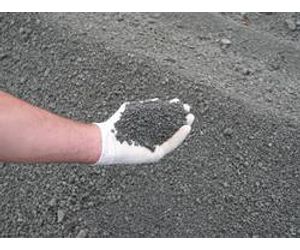
During solar drying a pasty mixture of sludge and water is transformed into a dry granule. As a result the mass of sewage sludge is reduced by 70-96%. All known possibilities for utilising sewage sludge remain after drying.
- Solar drying is not only reducing the amount of sewage sludge for disposal. The generated dry granule has a considerable caloric value.
- Actually, 1 ton of dried sewage sludge provides as much energy as 300 litres of fuel oil.
- However, as it is dried with the power of the sun its carbon footprint is very small.
The natural solar radiation is used for the evaporation of water in the solar drying plants. To protect the sewage sludge from the rain the drying area is covered with a transparent cladding.
Lateral the building area is bounded by guide tracks. These function as running surface for the SolarTiger and as foundation of the cladding.
The natural solar radiation impinges on the sewage sludge. The sludge warms up and the contained water evaporates. (The reason is a natural pressure equalisation between vapour pressure in the sewage sludge and the partial pressure of water in the air.)
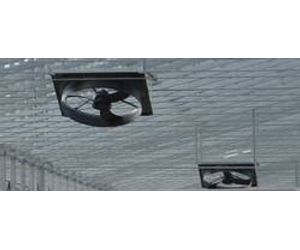
On the surface of the sludge a high relative humidity arises quickly. To transport this moist outside the hall air ventilators produce artificial wind on the surface of the sludge.
In the case of equal temperature moist air is lighter than dry air. The air exchange takes place through flaps in the roof.
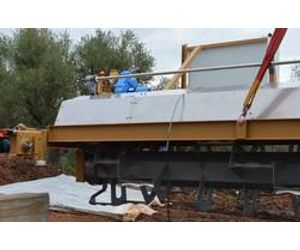
With the SplarTiger technology the sewage sludge is turned and aerated uniformly over the enitre width of the hall. The sludge can also be transported in the longitudinal direction of the hall.
With the SolarTiger technology only 20 – 25 kWh electrical energy per 1,000 l evaporated water are required
- To build a solar drying plant the underground has to be frost-proof.
The underground of the drying area can be carried out with asphalt like a street, or with a bottom of concrete
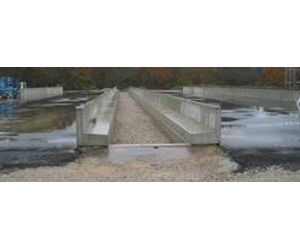
- The side walls which bound the drying area are often constructed with pre-cast concrete segments. These "L"-concrete stones combine several functions:
- sidewise boundary of the drying area
- foundation of the drying hall
- running surface for the rotating drum
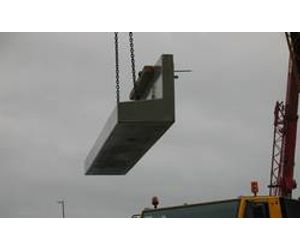
The galvanized steel construction of the drying hall has to be fixed at the pre-cast concrete segments. Different transparent roofings can be used:
- ETFE foil; high transparent and UV resistant
- Glass
- PE-foil as double-foil
- Burling foil
- Polycarbonate plates
- Nets
The material is chosen together with the customer.
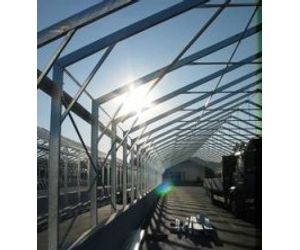
Aeration
- In- and outside the drying hall measurements are taking place to control the installed aeration.
- All climate data which are relevant for the controlling are evaluated and processed.
Completion
- At completion the rotating drum is put on the side walls and driven into the hall.
- After mounting the control system the start up can take place.