

- Home
- Companies
- Solartron Energy
- Products
- Solartron - Model SolarBeam - Hybrid ...
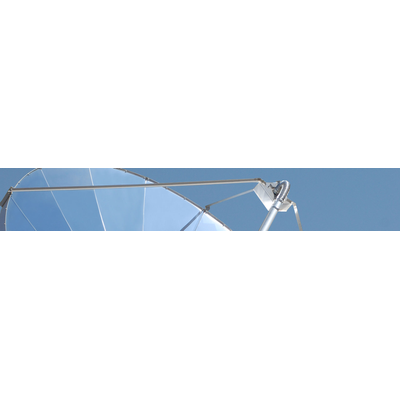
Solartron - Model SolarBeam -Hybrid Parabolic Solar Concentrator (Solar Dish)
The 9 meter hybrid parabolic solar concentrator (solar dish) continuously tracks the sun throughout the day using a dual axis tracker enabling the system to harvest maximum solar energy from early sunrise to late sunset. Most solar concentrator tracking technologies use an actuator for vertical tracking. The 9 meter solar concentrator uses a slew drive instead of an actuator for rock-solid reliability and more accurate control of the movement. Regardless of the season or latitude, the solar concentrator maintains a 0.1 degree sunlock accuracy.
As the solar concentrators follows the sun, the sun’s solar energy shines onto the collector, which has a highly reflective surface, and reflects the concentrated solar power onto a receiver at a magnification of 1000 X.
The advantages of a hybrid solar concentrator is that it can provide solar electricity and solar thermal power. A solar power plant can use the concentrating solar power for solar water desalination which further adds to the versatility of the system compared to conventional PV panels, solar parabolic trough, cpv fresnel systems, or solar power towers.
How a Solar Concentrator Works With HCPV / CPV Multi-junction Solar Cell Technology
In solar power plant applications that require solar electricity, the solar concentrator focus the light to the CPV Dense Array Module. A CPV Dense Array module consists of many multi-junction solar cell assemblies (triple junction solar cell) packaged onto one 10″x10″ module. The triple junction solar cell converts the concentrated solar power light into electricity. The advantage of using a CPV dense array module compared to fresnel cpv systems is that it is compact, low cost, and low maintenance.
How a Solar Concentrator Works With Direct Heat and A Free Piston Stirling Engine
In solar power plant applications that require only direct heat to power a system such as a stirling engine, the SolarBeam focuses all the concentrated solar power on the receiver head of the stirling engine. With a magnification of 1000 X and temperatures up to 800 Celsius, the heat generated by the sun’s energy, forces a piston to move which in turn spins a turbine that generates electricity.
How a Solar Concentrator Works With Thermal Fluid Heating
In solar power plant applications that utilize the high temperature heat such as ORC (Organic Rankine Cycle), a circulating pump circulates the thermal fluid through the absorber and the sun’s solar concentrated power heats up the fluid as it passes through.
The hot thermal fluid is circulated via a pump to a primary heat exchanger that transfers the thermal energy produced from the solar concentrator to the various applications. The cooled water is then recirculated back to the absorber where it starts the heating process again.
The 9M Solar Concentrator (Solar Dish) blends rugged design with art and functionality. Meticulous attention to detail starts from the mechanical design stage. Stress point simulation is performed on all major components to ensure maximum strength and durability.
The solar concentrator has been tested for 6 years in harsh winter climates to desert conditions to ensure performance, reliability, and low maintenance for solar power plant developers.
FEA (Finite Element Analysis) analysis tests are performed to calculate stresses and displacements of parts and assemblies under internal and external loads to optimize and validate the design. This rigorous testing is performed to ensure that the the solar concentrator can operate under extreme wind loads and soil conditions.
In many cases, the overall cost of making parabolic solar concentrators have hindered their use in utility scale solar power plant projects. The use of stamping dies and automotive manufacturing process has reduced the cost of manufacturing and allows for mass production.
The reflective petal is made of a special “glass-infused” anodized aluminum specifically engineered for maximum solar reflectance and superior corrosion resistance. The material is extremely light and durable – unlike glass, it will not break.
The dual-axis solar tracker uses a horizontal and vertical slew drive and all components are designed with high quality material including stainless steel bearings and robust electronics for long lasting performance and low maintenance. The skirting and trusses are made of high grade aluminum. All components are easily accessible for inspection.
The solar dish is engineered with zero optical alignment which eliminates the need for alignment of mirrors during the commissioning process. This reduces the cost of setup and installation. With the patented “quasi-shape” dish design, maximum reflective efficiency is achieved.
The 9M solar concentrator (solar dish) provides 45 KW of thermal energy @ 73% efficiency . This is made possible due to the accuracy of the petal design, reflectivity of the material, and high efficiency absorber.
When using the concentrated solar power for solar electricity, higher performance can be achieved by utilizing the patent-pending OLL (Optical Light Lens) technology. OLL technology is used with HCPV / CPV dense array modules to create an even distribution of light on the CPV module. Unlike convention Fresnel lens CPV systems that require a fresnel lens for each CPV solar cell, only one OLL is needed for the entire CPV dense array module. The OLL ensures accurate light distriubtion and improves the LCOE and is capable of generating 20 KW of electricity from one 20X20cm CPV module.
The solar concentrator has been tested in the harsh Northern hemisphere environment to ensure high performance and durability. The solar concentrator was engineered to handle any weather condition including high and low ambient temperature, snow & ice loading and strong winds. The system is designed for 20 + years of low maintenance operation.
The solar concentrator control system is a state-of-the-art tracking system that utilizes “EZ-SunLock” technology. With this technology, the system allows for fast setup and configuration. Thousands of control systems can be deployed in a solar power plant and configured with ease. The tracking system tracks with 0.1 degree accuracy and utilizes celestial tracking algorithm.
Communication
The solar concentrator is built to communicate via Ethernet & ModBus protocol and can be interfaced with the plant’s existing monitoring system. Each solar dish controller is daisy chained to each other.
Pressure Loss
If the pressure in the primary loop drops below 7 PSI, the solar concentrator automatically moves the dish to “safety stow” position.
Power Outage
In an event of a power outage, a UPS (Uninterrupted Power Supply) moves the dish to the “safety stow” position. When the power resumes, a 1 hour lock-out ensures that the UPS is charged before it resumes auto tracking.
Wind Monitoring
The SolarBeam tracks the sun in winds of up to 55km/hour. For winds that have a consistency above the default wind trigger speed, the solar concentrator tilts to its “safety stow” position.
Additional Features
- Operates in Northern and Southern Hemisphere
- Works in all latitudes
- Horizontal tracking: 360 degrees
- Vertical Tracking: 0 to 115 degrees
- Error monitoring for horizontal & vertical axis
- Temperature & flow monitoring
In any utility or industrial concentrated solar power plant application it is vital to know the status of your system to ensure continuous reliability and be alerted before an issue arises.
The solar concentrator has the capability to be monitored via the solar concentrator SCADA web dashboard. This dashboard is easy to use and provides critical information regarding the solar concentrator, status, diagnostics and energy production from the CPV multi-junction solar cell modules, Stirling engine, and steam engine.
Remote Setup & Control
The solar concentrator can be remotely configured and allows for immediate set point changes. The solar dish can be remotely controlled via mobile browser or PC which frees the technician from touching the control system.
Alerts & Triggers
In the event of an alarm or alert, the unit sends out an email to designated personnel. All alerts can be customized according to the notification the user wants to receive.
Diagnostics
The solar concentrator SCADA dashboard provides a diagnostics overview of the solar concentrator which includes: temperature and pressure status, energy production, etc. At one glance you know the status of the dish.
Reporting & Charts
In certain applications such as solar power electricity production (Stirling Engine), energy production reports can be generated for each dish. As well a chart and table is provided to visualize the daily production.
The solar concentrator (solar dish) was designed for large scale concentrated solar power plant installations and our engineers made it simple. The design allows for fast mounting of major components and does not require optical or mirror alignment. Flat land is not required and the solar concentrator can be installed on hills.
With only a crew of 3 people, one solar concentrator (solar dish) can be installed from start to finish within 8 hours. The solar dish was designed to have most components pre-assembled to reduce the installation time.
The spacing requirements for the solar concentrator are approximately 10 x 20 meters to ensure maximum solar harvesting with the least amount of shading.
Assembly Overview- The solar concentrator dish is designed to be assembled on the ground with the use of the Dish Mount Mechanical System (DMMS) that allows fast and easy installation of the trusses, reflective petals and skirting.
- The post is placed via a boom onto the foundation followed by the solar concentrator powertrain.
- Next, the completed dish is hoisted via boom and secured to the powertrain.
- The control system is mounted on the post and all quick connect plugs are installed to the powertrain control-interface board.
- The cooling assembly is secured and the absorber or electrical module (CPV / Stirling Engine) is installed and all necessary connections are performed.
Typical assembly time is 8 hours with 3 technicians.
Ideal Installation LocationsSuitable solar power plant sites should receive at least 2,000 kilowatt hours (kWh) of sunlight radiation per m2 annually, however the best solar power plant site locations receive more than 2,800 kWh/m2/year.
The most promising areas for solar power plant sites of the world include the following regions:
- South-Western United States
- Central and South America
- North and Southern Africa
- Australia
- the Mediterranean countries of Europe
- Middle East
- Desert plains of India & Pakistan
- Regions of the former Soviet Union
- Regions of China