


- Home
- Companies
- Biomasa Forestal SL
- Products
- Straw Pellet
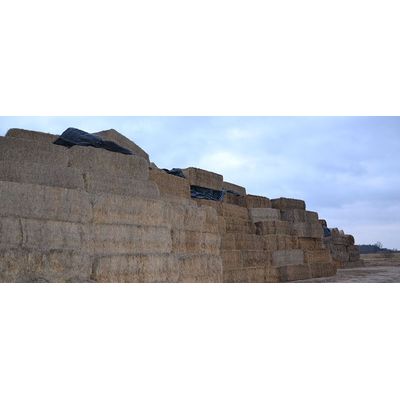
Straw Pellet
The straw pellets are perfect substitute for natural hay / straw to use as the bedding for horses or other animals. The pellets are easy to pour and economical to transport for longer distance. Straw pellets have very similar features as natural straw. In production, no additives arc used - only the mechanical pressing operation. Main export markets for the Straw pellets are: Germany, Belgium, Sweden, France, Finland and Austria. The straw pellet production starts at the end of field works in summer, usually in last weeks of July. After the crops are harvested, the waste of straw is collected, pressed into transportable rolls and stored. As the straw has low weight/volume ratio, it is only reasonable to transport it over short distance (~30km). For pellet production, the straw from near-by agricultural industries is collected. Crops from the field of 1 hectare size, given it`s fertility is 4 tons of grain, can be converted into 1,6 - 2 tons of straw.
After turning into the pellet - the same way as with wood pellets -Straw is again suitable to transport over long distances. Pellets have much better weight/volume ratio, but does not loose the function and features. Very important measure in the straw quality that it has to be clean and clear from any chemicals. Although it is not harmful for animals, it is still not recommended to use it as feedstuff in any case. Reason is the rainwater, soaked by straw while it`s on field - it may have certain amount of dissolved materials.
Although many crops (rape, barley, triticale, rye) can be successfully pressed into pellets, the most valuable is the wheat. The wheat has light color and good absorption value. The straw pellets can be used for heating purposes as well. Important factor is boiler - it has to be suited for greater amount of ash and slag.
As for heating purpose, the wheat straw pellets are know to produce the least ashes (compared to some other crops, like rape or rye). The straw pellets conform the industry standard norm CEN/TS. Heating values of straw pellets, if used for fuel:
To keep the high quality of straw during the whole year, it has to be carefully protected from the rain and have sufficient ventilation as well. Otherwise, there is a threat of mold. Before pclletizing, the straw is measured for humidity. Only the straw with < 20% of moisture is passed to the line.
The pelletization process has four major stages: 1) scratching out the straw rolls, 2) cycloning and pressing through the pellet matrix, 3) cutting and transporting to the colling unit, 4) pouring into big bags. In the pressing phase, the pellets are treated in the 90-95°C temperature, killing any biological activity in straw.
The output from the line of pellets is the 8mm diameter, the pellets are 2-4 cm long. The harder they are pressed, the darker the color (because of heat), also pellets tend to be shiny. Normal pellets are mat, density is 550 to 600 grams per liter, yellowish color. Moisture is always < 15 %, typically 9-10 %. Anual capacity of straw pellets is 6000 tons.
TIPS for stables:
If used as bedding, the average intake of a 10m? stable is about 1300 kg a year. One truckload of pellets is sufficient for one month for the stable of - 2000 m? floor space.
BEDDING FOR SMALL ANIMALS - Granulate
For smaller animal bedding - chicken, rabbits - we offer the Granulate. The Granulate is a byproduct of straw pellets. Simply speaking -the smashed pellets. The granulate has the same or better absorption values as normal pellets, just there arc more pieces and lower volume/weight ratio. It is more suitable for smaller containers.
The straw pellets can be packed into 13 kg, 16 kg or 20 kg small bags; also, into 1100 or 1000 kg Big bags.
The Granulate (smashed straw pellets) can be cither packed into 14 kg bag or into 900 kg big bag.
The small bags arc transparent, no name polyethylene bags, heat-welded at the end. The Big bags arc polypropylene white color no name bags with opening on top and bottom of bags; with special handles to lift with forklift. Big bags arc transported onto pellets if the hard-sided (fridge) trailer is loaded and no pallets if the tent (tilt flatbed) trailer is loaded.
The small bags and big bags logistics (certain combinations of bags available):