

Thermal Accumulators (Puffer)
A heat storage tank is a tank in which the thermal agent (water, antifreeze, ice) is accumulated and which releases it when needed. A puffer is indispensable when you want to make the heating system of a building more efficient.
Examples of use are balancing energy demand between day and night, storing heat accumulated in summer for heating in winter or storing cold accumulated in winter for air conditioning in summer. Thermal energy accumulators can significantly contribute to meeting society`s needs to use energy in an efficient and environmentally friendly way. The puffer plays an important role in energy conservation and can generate fuel savings.
Interest in renewable energy has increased due to the challenges posed by global warming. Efforts are being made worldwide for the exploitation of renewable energy sources. However, renewable energy fluctuates and so with increased renewable energy production comes an increased need for energy storage to ensure the availability of clean energy when the wind isn`t blowing or the sun isn`t providing solar energy. Heat/cold storage can help with this as well.
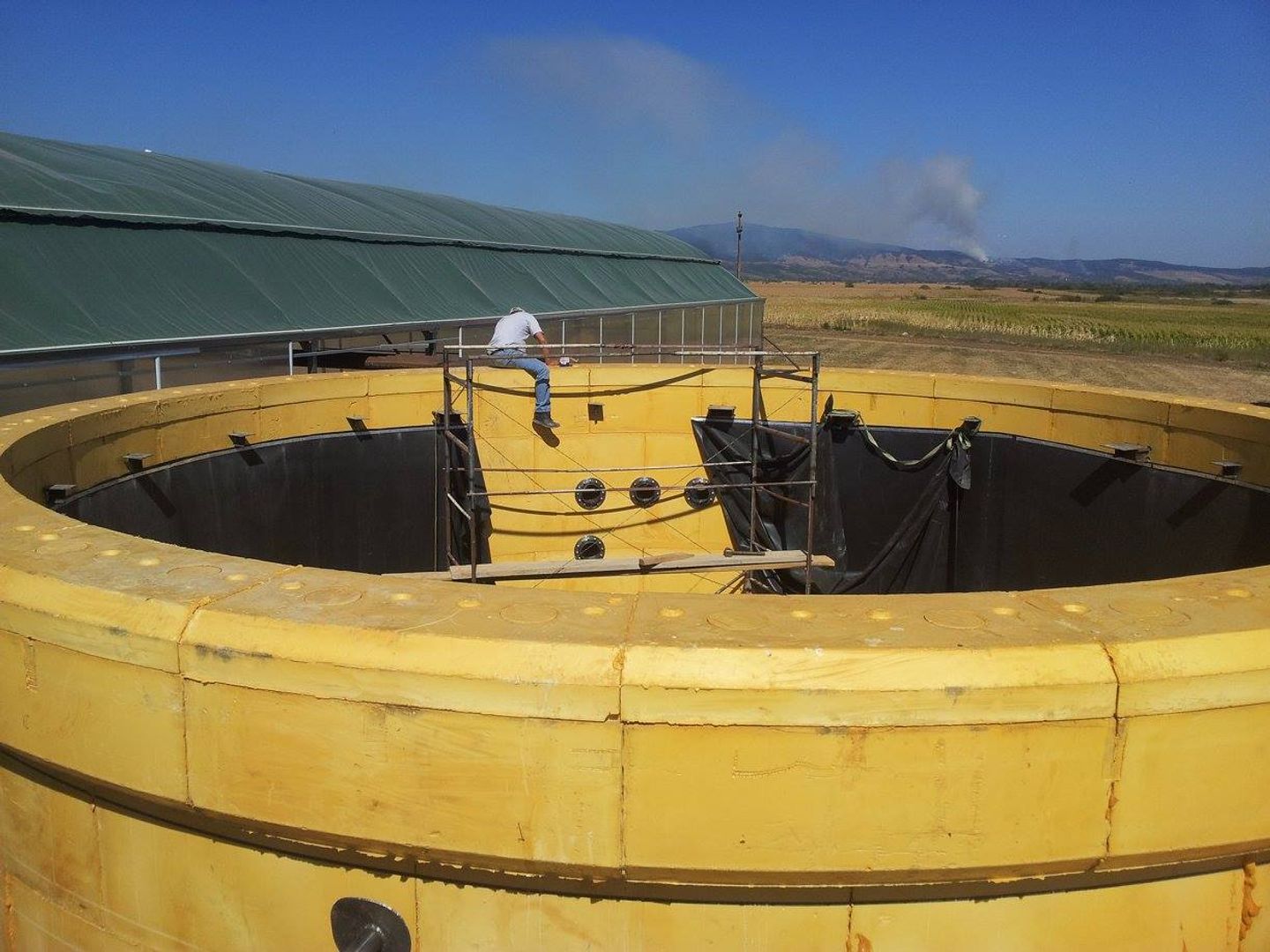
The heat/cold storages made by Dia Doxa Folex from PUR-ICF closed-cell polyurethane modular elements are underground (recommended) or above-ground cylindrical constructions containing water/antifreeze or ice that accumulate thermal energy (heat or cold) for heating/cooling (air conditioning) of homes.
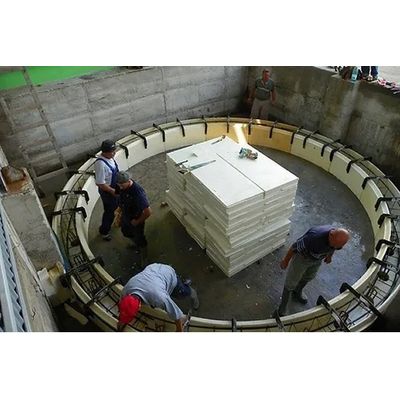
The PUR-ICF closed-cell polyurethane modular elements are the best thermal insulation materials on the market and are presented in the form of cylindrical sectors with a thickness of 400 mm, a height of 600 mm and a length in the axial plane of 1200 mm, which have inside a network of vertical and oblique channels in which the reinforcement is mounted and the concrete is poured.. After their installation, the positioning of the reinforcements and the pouring of concrete in the network of channels results in the resistance structure of reinforced and latticed columns, thus obtaining a monolithic construction . The fact that the concrete fills the structure both vertically and obliquely ensures the structure increased resistance. The thermal accumulator made of polyurethane elements has a special durability and resistance to external factors, namely special resistance to the action of wind, vibrations,
Heat/cold storages can have capacities between 10 mc and 600 mc, depending on the storage requirement of heat/cold.
The heat/cold storages made with such modular elements accumulate thermal energy (on average) of 50 KWh/m3. As an example, a 200 m3 storage tank with water at 90 degrees Celsius has an accumulation of 10,000 KWh.
- Pour the foundation and the reinforced concrete slab in the lower part (base of the storage)
- Mount the PUR-ICF belt elements resulting in a reinforced (lower) ring and mount polyurethane plates at the base of the storage over which the reinforcement is mounted
- Concrete is poured into the ring (lower belt) and at the base of the storage.
- Position 3-4 rows of sector-cylindrical PUR-ICF elements 1200x600x400mm
- Mount the second belt ring.
- Mount the reinforcements in the columns and ring and pour concrete into them.
- Continue with the next row of sector-cylindrical elements and the belt ring if necessary.
- The internal waterproofing with polyurea is applied, and the magnesium oxide plates are mounted on the outside (in the case of above-ground storage) on which the final finish is applied.
- Mount the heat/cold exchanger inside
- Mount the storage tank cover (insulated with polyurethane plates) or, if necessary, pour a reinforced concrete plate, thermally insulated with polyurethane plates.