


- Home
- Companies
- ThyssenKrupp Uhde GmbH
- Products
- Vanadium Redox Flow Battery (VRFB)
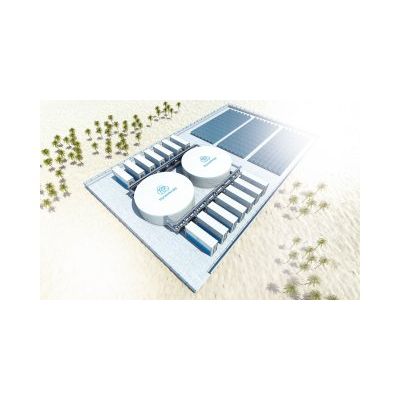
Vanadium Redox Flow Battery (VRFB)
A vanadium redox flow battery (VRFB) is an energy storage device that converts electrical energy into chemical energy by the redox reaction of dissolved vanadium. Since the energy is stored in this vanadium-containing electrolyte, the amount of electrolyte defines the energy storage capacity for the whole system.
The redox reaction takes place in a series of cells, and the number of cells and the cell area define the power of the system. Energy capacity and power can therefore be scaled independently. Due to the dissolved vanadium and the use of corrosion-resistant components made of graphite and fluorinated polymers, the life cycle of a VRFB is expected to be more than twenty years. After the end of the life cycle the vanadium within the electrolyte can be recycled and used again.
thyssenkrupp Uhde Chlorine Engineers develops new large-scale vanadium redox flow batteries with a single cell area of up to 2.5 m2. This enables thyssenkrupp Uhde Chlorine Engineers to take advantage of economies of scale and to provide cost-effective systems starting from 1 MW to several hundred Megawatts. A new cell design allows high flow rates while still maintaining a low pressure drop across the cell, facilitating high system efficiencies.
- Industrial scale VRFBs can balance fluctuations in power generation by solar and wind power plants with energy consumption requirements
- High cell area of up to 2.5 m2 allows economies of scale and makes it possible to realize very cost-effective systems
- Independent scalability of power range and energy capacity allows a customized system tailored to requirements
- Long life cycle of up to twenty years or more
- High energy efficiencies
- Fully recyclable electrolyte