


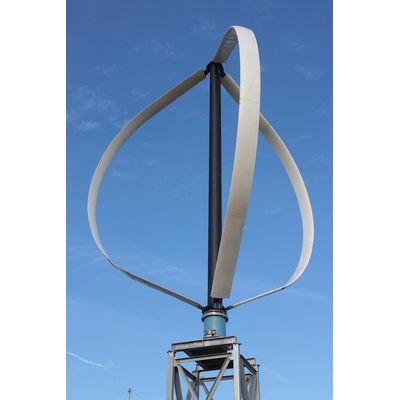
ArborWind - Vertical Axis Wind Turbine
The Vertical Axis Wind Turbine is a wind power generation design that puts the main rotor shaft transverse to the wind. The main components of the system are located at the base of the tower on which the vertical blades sit. This differs from the more common Horizontal Axis Wind Turbine (HAWT), where the blades attached at the horizontal rotor shaft. The gearbox and other pointing equipment are at the top of the pole hundreds of feet off the ground.
In a VAWT design, there is no need for pointing mechanisms as the blades are omnidirectional, meaning they catch the wind regardless of direction without needing to reorient the turbine blades. Along with attributes that make it easier to maintain, the VAWT design allows for closer placement so more turbines can be located in the same area as HAWTs.
First, let’s describe how a Horizontal Axis Wind Turbine (HAWT) works. The HAWT system uses asymmetrical airfoil blades and is regular adjustmented to catch the wind. A HAWT requires mechanisms to adjust the pitch of the blades and to rotate the turbine into the wind. It
also requires a gearbox to adjust the generator shaft’s rotational speed. All these items increase inefficiency and maintenance. That maintenance, by the way, is at the top of an 80-meter pole.
The Vertical Axis Wind Turbine (VAWT) has a much different profile. The blades are symmetrical and they are oriented vertically. This means they are always catching the best wind, and don’t have to be artificially oriented to maximize electricity generation.
The mechanical complexity of the VAWT is much less than the HAWT, reducing the need and complexity of maintenance. Most of any maintenance can be done at ground level. Since the blades are connected at both ends, there is less fatigue stress to the blades. There are a number of other advantages to the VAWT that we’ll mention in a moment.
Up until the advent of the ArborWind PT180, VAWTs were not being used to the same extent as HAWTs because of durability and reliability issues. They also had a slightly lower theoretical coefficient of performance than a HAWT, But the biggest problems (Prior to the PT180) is that traditional Vertical Axis Wind Turbines were always trying to shake themselves apart. These two issues are the most compelling reasons that Vertical Axis Wind Turbines failed to gain general acceptance in the commercial world. It also happens to be two of the issues that, through its proprietary technology, ArborWind has solved. Find out more about Our Technology here.
Up until the advent of the ArborWind PT180, VAWTs were not being used to the same extent as HAWTs because of durability and reliability issues. They also had a slightly lower theoretical coefficient of performance than a HAWT, But the biggest problems (Prior to the PT180) is that traditional Vertical Axis Wind Turbines were always trying to shake themselves apart. These two issues are the most compelling reasons that Vertical Axis Wind Turbines failed to gain general acceptance in the commercial world. It also happens to be two of the issues that, through its proprietary technology, ArborWind has solved. Find out more about Our Technology here.
The VAWT, when issues such as durability and wind speed matching are taken care of (such as in the PT180), becomes a superior solution for many applications. Just some of those reasons include:
- Omnidirectional wind capture
- A small footprint
- Multiple units do not require the huge setback that HAWTs require
- Quicker installation
- Low maintenance that is primarily at ground level
All of the reasons listed above make a VAWT system superior in most applications of interest to commercial and industrial developers, investors and utilities. The VAWT system, and in particular the ArborWind PT180 provides more electrical energy at a given wind speed. It has lower manufacturing costs and that translates into lower purchase costs. The reality is that there are fewer maintenance and operational costs associated with VAWTs. For investors, that means a quicker Return On Investment.
In the United States, there has begun to be a bit of pushback on utility-scale wind farms as they encroach on anything but the most remote areas. Shadow flicker, rhythmic noise and wildlife endangerment are being used to circumvent attempts to bring this power solution to many areas. The VAWT answers every single one of these concerns and even more that are not mentioned here. It is what makes a vertical design such as the PT180 perfect for the broadest array of applications. From rural to urban, from commercial buildings to government buildings, it is a world-changing solution.
Since wind power and solar power have different peak production times, the concept of putting these two renewable energy solutions together makes sense to increase the amount of daily production in one location. VAWTs over HAWTs work better in this scenario for a
variety of reasons.
First, the smaller footprint of a VAWT like the PT180 will mean more space for solar production. Second, maintenance won’t require access to huge cranes that will need their own offsets. Finally, the reduced shadowing of a VAWT over a HAWT should also be considered in a mixed facility.
Call it what you will–Distributed Energy or Distributed Generation—the concept is the same: Locating the power generator at or near the point of consumption. Distributed Generation (DG) has a number of advantages in reduced energy losses through long transmission lines, reduced load on those distribution lines, and alternative power generation where transmission lines are absent or impossible. Distributed wind power comes in all shapes and sizes. A U.S. Department of Energy study puts the number of sites where distributed wind is technically feasible at just under 50 million residential, commercial or industrial sites.
In order to create a world-changing Vertical Axis Wind Turbine (VAWT), ArborWind had to address some serious design issues that held back other VAWT designs.
The successful completion of that work is the ArborWind PT180, a VAWT that is durable, economical, safe and efficient. That’s world-changing technology.
The PT-180 is a Vertical Axis Wind Turbine (VAWT) using proprietary technology that delivers superior performance, durable design, increased generation efficiencies and fits into nearly every application imaginable (you need wind of course). It does this using proven technology that is more cost effective to build, operate and maintain than other wind turbine designs.
ArborWind holds a U.S. patent on four aspects of its PT180 VAWT design. That includes the strut-free structural composite blades, the continuous monopole tower, the electronic controller, and the elimination for the need of a gearbox. These design components lead to greater generation efficiencies, lower operating losses, and durable, long-term operation.
ArborWind has years of stable operation documentation that proves the reliability of the PT180 outperforms any other current or previous VAWT design. It’s why the PT180 has an estimated useful life of 50 years – 30 years longer than the service-life of Horizontal Axis Wind Turbines (HAWTs).
The VAWT design – and in particular, the PT180 – provides increased safety for people and wildlife. This new design creates an opportunity for use in areas where a HAWT design was not feasible, or even dangerous. A clean, economical, low-cost answer to the world’s energy needs makes the PT180 special.
The ArborWind PT180 is a distributed power Vertical Axis Wind Turbine (VAWT). It is rated to generate 60 kW – 180,000 kWh/yr at 7 m/s average wind speed. As a VAWT, the PT180 is omnidirectional, removing the requirement for external yaw manipulation. The PT180 includes wind-speed-matching technology, allowing for efficient use at varied wind speeds. The PT180 includes a 100-foot patented monopole tower and direct-drive generator system. Other advantages to the PT180 include:
- More electrical energy at a given wind speed
- Lower purchase and installation costs
- Lower sensitivity to gusting, changing winds
- Longer life due to decreased blade-fatigue loads
- Lower life-cycle costs due to simplified design
- Fewer moving parts
- Easier servicing
- Smaller footprint and lighter weight
- Safe for urban use
- Meets requirements for low noise systems
The PT180 is the result of years of computer-assisted design refinements that have perfected the turbine’s patented design elements. This refinement includes eight years of operation of a PT180 prototype near Marshall, Michigan. ArborWind designers have all these years of actual operational data to document stability and economic operation.